Chat on WhatsApp

How to Scale Your Store with Advanced Shopify Development Solutions

In a fast-moving eCommerce landscape, having a Shopify store alone is no longer enough. Modern consumers expect faster performance, personalized shopping experiences, and seamless interactions across devices. As your business grows, the need for advanced features becomes inevitable. Shopify provides the perfect foundation for this growth, but scaling successfully requires strategic development, automation, and customization. This is where partnering with a Shopify development company and either choosing to hire a Shopify expert becomes invaluable.

Scaling a store is more than attracting more visitors it’s about enhancing your store’s ability to handle increased demand while maintaining an exceptional customer experience. With advanced Shopify development solutions, businesses can streamline operations, optimize storefronts, and create a customer journey that drives conversions at every stage.

This comprehensive guide explores how you can scale your store using advanced Shopify development, along with the importance of hiring expert professionals to support long-term success.

Why Scaling Your Shopify Store Matters

As your store grows, customer expectations increase. They expect seamless navigation, fast page loads, quicker checkout, and highly personalized product recommendations. Without a scalable structure in place, your store may experience slow performance, inaccurate inventory tracking, or increased cart abandonment.

Advanced Shopify development ensures your store evolves alongside your business. When you hire a dedicated Shopify developer, you get the technical support needed to overcome scaling challenges—whether it’s building custom features, improving speed, or automating complex operations.

The Power of Advanced Shopify Development for Store Growth

Scaling is not just about adding new products; it’s about creating a smarter, more efficient system. Shopify’s flexibility allows businesses to integrate custom solutions that elevate the entire shopping experience.

Custom Theme Development for a Unique Brand Experience

A generic theme works initially, but scaling requires a unique digital identity. With custom theme development, you can transform your storefront into a visually appealing, conversion-focused customer experience. Businesses often hire Shopify experts to create tailored layouts, optimized coding structures, and advanced UI/UX enhancements that reflect their brand vision while maximizing conversions.

Headless Shopify for Exceptional Performance

As brands grow, adopting headless commerce has become a popular strategy. By decoupling the frontend from the backend, businesses can deliver lightning-fast shopping experiences using technologies like Next.js or React. Headless Shopify systems provide unmatched flexibility, allowing for dynamic interfaces and global scalability. A seasoned Shopify development company can help implement headless architecture effectively.

Custom Shopify App Development for Specialized Needs

Pre-built apps are great, but not every business finds the perfect fit. As you scale, you may need custom functionalities like automated shipping logic, detailed inventory systems, CRM integrations, or loyalty program tools. This is when businesses prefer to hire dedicated Shopify developers who can build custom apps tailored to their unique workflows.

Automation: The Secret Weapon for Scalable Shopify Growth

Automation helps eCommerce businesses streamline tasks that would otherwise require significant time and resources. Shopify’s automation capabilities help you scale without increasing manpower or operational overhead.

Inventory & Order Management Automation

Manually updating stock is time-consuming and prone to errors. Advanced Shopify automation ensures stock levels sync across all platforms, warehouses, and channels. Automated order routing and notifications reduce fulfillment delays and improve accuracy.

Marketing Automation for Higher Engagement

Email sequences, abandoned cart reminders, and personalized recommendations can be automated using Shopify apps or custom integrations. A Shopify development company can help embed AI-driven segmentation tools to improve targeting and boost customer retention.

Analytics & Reporting Automation

Custom dashboards and reporting tools help store owners track customer behavior, sales trends, and product performance. Automation removes the guesswork and helps you make informed decisions.

Building a High-Performance Shopify Store

Page speed and user experience significantly influence conversion rates. As your store grows, maintaining performance becomes essential.

Speed Optimization

Advanced optimization techniques include:

  • Liquid code optimization
  • Script and app cleanup
  • Image compression and lazy loading
  • Mobile performance improvements

When businesses choose to hire Shopify experts, they gain access to specialized skills that ensure faster load times and improved site performance.

Improved Checkout Experiences

Shopify Plus users can customize their checkout flows to reduce friction. Features like one-click checkout, auto-filled forms, and smart payment integrations can significantly increase conversions.

Advanced UX Features

Interactive product galleries, smart search filters, real-time cart updates, and personalized recommendations all contribute to a better shopping experience. A professional Shopify development company can design these features to align with your brand identity.

Integrating Essential Tools for Seamless Scaling

Scaling your Shopify store requires integrating various systems that support business operations.

ERP & CRM Integrations

Integrating Shopify with ERP or CRM systems ensures smooth data flow between departments. This improves inventory accuracy, customer management, and forecasting.

Shipping Integrations

Real-time shipping updates, automated label generation, and warehouse integrations simplify order fulfillment. These systems reduce errors and improve delivery times, especially when supported by custom development.

Payment Gateway Enhancements

Scaling internationally requires support for multiple currencies and local payment methods. Custom payment gateway integrations can increase customer trust and drive global sales.

Data-Driven Scaling Through Advanced Analytics

Data is your most powerful scaling tool. Understanding customer behavior helps businesses refine their strategies and improve growth.

Advanced Shopify development enables:

  • heatmaps
  • conversion funnel tracking
  • product performance analytics
  • AI-based forecasting tools

These powerful insights allow businesses to scale cost-effectively and boost profitability.

Expanding Your Business with Multi-Channel Selling

Scaling often means expanding your presence beyond your online store. Shopify supports integration with platforms like Amazon, eBay, Instagram, TikTok, and Google Shopping. Multi-channel selling increases visibility and drives new revenue streams, while synced inventory and orders keep operations smooth.

This is another area where businesses prefer to hire dedicated Shopify developers, ensuring all integrations run perfectly.

Why You Should Work with Shopify Professionals

While Shopify is user-friendly, advanced scaling requires deep technical knowledge. Partnering with a professional Shopify development company ensures your store remains optimized, secure, and capable of handling significant growth. When you hire Shopify Experts, you gain access to developers who understand Liquid, Shopify APIs, theme architecture, app development, and headless commerce.

Whether you need a complete redesign, advanced automation, or custom integrations, expert Shopify developers can transform your store into a high-performing eCommerce system.

Final Thoughts

Scaling your Shopify store is not an overnight process. It involves advanced development techniques, custom integrations, performance optimization, and a well-planned data strategy. Shopify provides the foundation, but to achieve true growth, businesses often choose to hire dedicated Shopify developers or collaborate with an experienced Shopify development company.

With the right development solutions, your Shopify store can evolve into a powerful, scalable, and profitable online business. Whether you want to enhance customer experiences, expand your global reach, or automate operations advanced Shopify development is the key to long-term success.
Building AI-Native Applications: The Role of Agents, Generative AI & Live Intelligence

Are you planning to build smarter applications that don’t just work but actually think, adapt, and respond in real time?

Then you’re already looking in the right direction.

AI-native applications are no longer a future concept. They are becoming a business necessity. From automation to personalization, companies are now moving toward systems that can understand data, make decisions, and continuously improve.

And the core of this transformation revolves around three key elements: AI agents, generative AI, and live intelligence.

In this guide, you’ll understand how these components work together and what it actually takes to build AI-native applications.

What Are AI-Native Applications?

AI-native applications are built with intelligence at their core.

Unlike traditional apps that rely on fixed workflows, these systems use data, context, and learning models to adapt in real time. They don’t just execute commands, they understand intent and respond accordingly.

This shift is happening because businesses now want faster decisions, better personalization, and systems that can scale with complexity.

Why Businesses Are Moving Toward AI-Native Applications

The demand for AI-native systems is growing rapidly, and there are clear reasons behind it.

  • Businesses are dealing with massive amounts of data
  • Users expect personalized experiences
  • Decision-making needs to be faster
  • Automation alone is no longer enough

Modern applications need to do more than just function. They need to think, learn, and improve continuously.

Key Components of AI-Native Applications

To build a truly intelligent application, you need to understand the core components behind it.

  1. AI Agents

AI agents are responsible for decision-making and execution.

They can analyze data, take actions, and automate workflows without constant human input. Instead of just assisting, they actively perform tasks and optimize outcomes over time.

  1. Generative AI

Generative AI enables applications to create content, responses, and interactions dynamically.

It helps systems understand user queries, generate meaningful outputs, and deliver personalized experiences instead of fixed responses.

  1. Live Intelligence

Live intelligence ensures that applications operate on real-time data.

It allows systems to respond instantly, update decisions dynamically, and stay aligned with current conditions rather than relying on outdated information.

Must-Have Features of AI-Native Applications

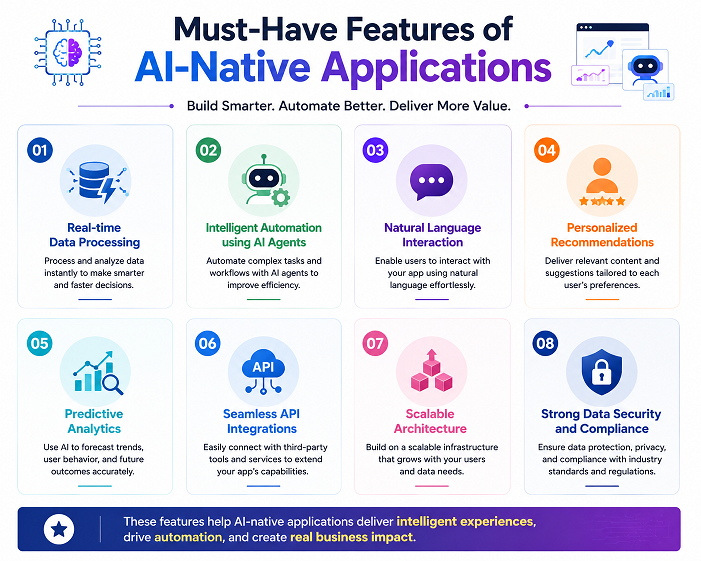
If you want to build a competitive AI-native application, these are the essential features you should include:

  • Real-time data processing
  • Intelligent automation using AI agents
  • Natural language interaction
  • Personalized recommendations
  • Predictive analytics
  • Seamless API integrations
  • Scalable architecture
  • Strong data security and compliance

These features help applications move from basic functionality to intelligent performance.

Step-by-Step Process to Build AI-Native Applications

Building AI-native applications requires a structured approach. Here’s how the process typically works.

  1. Define the Problem and Use Case

Start by identifying where AI can create real value.

Focus on areas where decisions can be improved, processes can be automated, or user experience can be enhanced.

  1. Data Collection and Preparation

Data is the foundation of any AI system.

Clean, structured, and relevant data is essential for training models and ensuring accurate results.

  1. Choose the Right AI Models

Depending on your use case, you may need machine learning models, large language models, or custom AI solutions.

Choosing the right model directly impacts performance.

  1. Design the System Architecture

AI-native applications require scalable and flexible architecture.

This includes backend systems, APIs, data pipelines, and real-time processing capabilities.

  1. Develop and Integrate Components

This is where everything comes together.

AI agents, generative AI models, and real-time data systems are integrated into the application.

  1. Testing and Optimization

AI systems need continuous testing.

You need to monitor performance, improve accuracy, and optimize workflows based on real usage.

  1. Deployment and Continuous Improvement

After launch, the work doesn’t stop.

AI-native applications evolve over time, improving through data, feedback, and updates.

Technology Stack for AI-Native Application Development

Choosing the right tech stack is critical for performance and scalability.

Here are commonly used technologies:

  • Frontend: React, Angular, Vue.js
  • Backend: Node.js, Python, Java
  • AI/ML Frameworks: TensorFlow, PyTorch
  • Generative AI: OpenAI APIs, LLMs
  • Data Processing: Apache Kafka, Spark
  • Cloud Platforms: AWS, Google Cloud, Azure
  • Databases: PostgreSQL, MongoDB

The right combination depends on your project requirements and scale.

Cost of Building AI-Native Applications

The cost of AI-native application development depends on several factors.

  • Complexity of the application
  • Number of AI features
  • Data infrastructure
  • Integration requirements
  • Development team location

Here’s a rough estimate:

Application TypeEstimated CostTimeline
Basic AI App$10,000 – $25,0002–4 Months
Mid-Level AI App$25,000 – $60,0004–8 Months
Advanced AI System$60,000+8+ Months

As seen in similar development models, costs increase with complexity, features, and scalability requirements.

Challenges in AI-Native Application Development

While the opportunities are huge, there are also challenges.

  • Poor data quality can affect results
  • High infrastructure requirements
  • Security and privacy concerns
  • Continuous model training and updates
  • Integration complexity

That’s why having the right development approach and expertise matters.

Final Thoughts

AI-native applications are not just an upgrade to traditional systems.

They represent a complete shift in how software is built and experienced.

By combining AI agents, generative AI, and live intelligence, businesses can create systems that are faster, smarter, and more adaptive.

And as technology continues to evolve, this approach will become the standard for modern application development.

Frequently Asked Questions

  1. How much does it cost to build an AI-native application?

The cost depends on complexity, features, and integrations. Basic applications cost less, while advanced systems with real-time intelligence require higher investment.

  1. How long does it take to develop an AI-native app?

A basic version can take a few months, while complex systems may take 6–10 months depending on requirements.

  1. What industries can benefit from AI-native applications?

Industries like healthcare, finance, eCommerce, SaaS, and recruitment can benefit the most due to high data usage and decision-making needs.

  1. Are AI-native applications secure?

Yes, if built correctly. Security measures like encryption, authentication, and compliance protocols help protect user data.

  1. Can AI-native apps scale over time?

Yes, scalability is one of their biggest advantages. They are designed to grow with data, users, and business needs.

Next-Gen App Development: AI, Automation & the Future of Digital Products

Digital products are no longer just functional tools. They are evolving into intelligent ecosystems that learn from user behavior, adapt in real time, and continuously improve without constant manual updates. This transformation is not just a trend, it is redefining how businesses design, build, and scale applications.

From startups to large enterprises, companies are shifting toward AI-driven architectures and automated workflows to stay competitive. The demand for intelligent, scalable, and user-centric applications is pushing development beyond traditional boundaries. Understanding this shift is essential for any business planning to build future-ready digital products.

The Evolution from Traditional to Intelligent Applications

Earlier, application development followed a linear approach. Teams defined requirements, built features, tested them, and released updates periodically. While this model worked for years, it struggled to keep up with modern user expectations.

Today’s users expect:

  • Instant responses and real-time updates
  • Personalized experiences tailored to their behavior
  • Seamless performance across devices and platforms
  • Continuous improvements without disruptions

Traditional apps cannot meet these expectations efficiently. This is where next-gen app development comes in, focusing on systems that are dynamic, responsive, and capable of learning from data.

What Makes Next-Gen App Development Different?

Next-gen app development is built on intelligence and automation at its core. Instead of static logic, these applications use data-driven models to evolve continuously.

Core characteristics explained in depth:

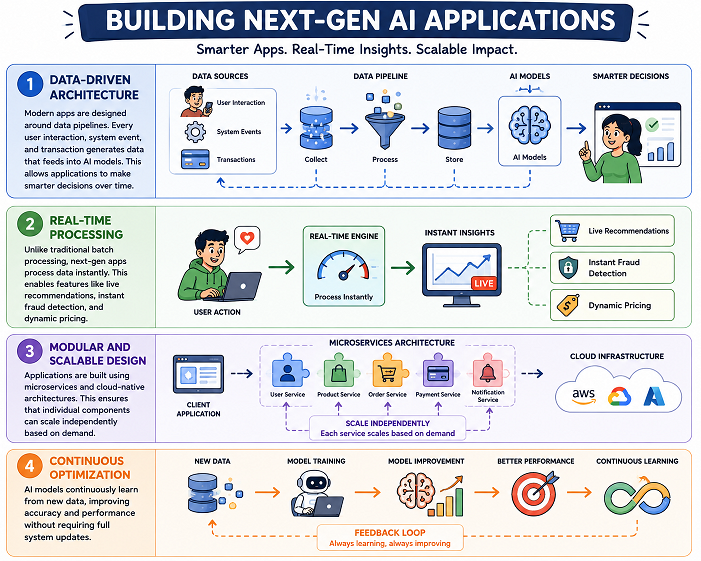
  1. Data-Driven Architecture
    Modern apps are designed around data pipelines. Every user interaction, system event, and transaction generates data that feeds into AI models. This allows applications to make smarter decisions over time.
  2. Real-Time Processing
    Unlike traditional batch processing, next-gen apps process data instantly. This enables features like live recommendations, instant fraud detection, and dynamic pricing.
  3. Modular and Scalable Design
    Applications are built using microservices and cloud-native architectures. This ensures that individual components can scale independently based on demand.
  4. Continuous Optimization
    AI models continuously learn from new data, improving accuracy and performance without requiring full system updates.

Deep Dive: The Role of Artificial Intelligence

Artificial Intelligence is the backbone of next-generation digital products. It transforms applications from rule-based systems into intelligent platforms capable of reasoning and learning.

Key AI components in detail:

Machine Learning Models
These models analyze historical and real-time data to identify patterns. For example, an e-commerce app can predict what a user is likely to purchase next based on past behavior.

Natural Language Processing (NLP)
NLP allows applications to understand and respond to human language. This powers chatbots, virtual assistants, and voice-enabled interfaces.

Computer Vision
Used in applications that process images or videos, such as facial recognition, medical imaging, and security systems.

Recommendation Systems
These systems personalize user experiences by suggesting relevant content, products, or actions based on user preferences.

Businesses aiming to build intelligent systems often hire AI developer experts who understand how to design, train, and deploy these models effectively.

Automation Across the Entire Development Lifecycle

Automation is not limited to one stage of development. It is integrated across the entire lifecycle, making processes faster, more reliable, and less dependent on manual effort.

In-depth look at automation stages:

  1. Requirement Analysis
    AI tools analyze business requirements and convert them into technical specifications, reducing ambiguity and speeding up planning.
  2. Code Generation
    Modern development tools can generate code snippets or even complete modules based on predefined logic, reducing development time.
  3. Automated Testing
    AI-driven testing tools identify bugs, generate test cases, and ensure quality without manual intervention.
  4. Continuous Integration and Deployment (CI/CD)
    Automation pipelines ensure that code changes are tested and deployed quickly, enabling faster releases.
  5. Monitoring and Maintenance
    Automated monitoring systems detect performance issues and resolve them proactively, ensuring minimal downtime.

Business Impact: Why AI and Automation Matter

The integration of AI and automation delivers significant business value beyond just technical improvements.

Detailed benefits:

Operational Efficiency
Automation reduces repetitive tasks, allowing teams to focus on strategic activities.

Cost Reduction
By minimizing manual effort and optimizing resource usage, businesses can lower operational costs.

Improved Decision-Making
AI provides real-time insights, enabling faster and more accurate decisions.

Enhanced Customer Experience
Personalized interactions and faster responses improve user satisfaction and retention.

Scalability and Flexibility
Cloud-based architectures and automation allow businesses to scale without major infrastructure changes.

Working with a reliable AI app development company ensures these benefits are implemented with the right strategy and technical expertise.

Core Technologies Powering Next-Gen Applications

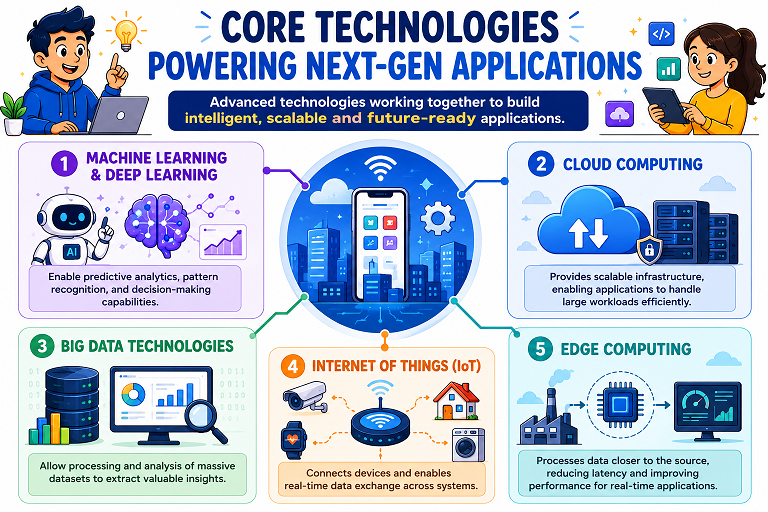
Next-gen app development is supported by a combination of advanced technologies that work together to create intelligent systems.

Detailed breakdown:

Machine Learning and Deep Learning
Enable predictive analytics, pattern recognition, and decision-making capabilities.

Cloud Computing
Provides scalable infrastructure, enabling applications to handle large workloads efficiently.

Big Data Technologies
Allow processing and analysis of massive datasets to extract valuable insights.

Internet of Things (IoT)
Connects devices and enables real-time data exchange across systems.

Edge Computing
Processes data closer to the source, reducing latency and improving performance for real-time applications.

Industry-Wise Applications of Next-Gen Development

AI and automation are transforming industries by enabling smarter and more efficient applications.

Healthcare

AI-powered systems assist in diagnostics, patient monitoring, and predictive healthcare, improving outcomes and reducing costs.

Finance

Applications use AI for fraud detection, risk analysis, and automated financial services, ensuring security and efficiency.

E-commerce

Personalized recommendations, chatbots, and automated inventory systems enhance customer experience and operational efficiency.

Real Estate

AI-driven platforms provide property recommendations, market insights, and virtual tours, improving decision-making for buyers and sellers.

Manufacturing

Predictive maintenance and automated production systems reduce downtime and improve efficiency.

Challenges in Implementing AI and Automation

Despite its advantages, next-gen app development comes with challenges that businesses must address carefully.

Key challenges explained:

Data Privacy and Security
Handling sensitive data requires strict compliance with regulations and robust security measures.

Integration with Legacy Systems
Existing systems may not be compatible with AI-driven architectures, requiring careful planning.

High Initial Investment
Developing intelligent systems can require significant upfront investment.

Skill Gap
There is a shortage of professionals with expertise in AI, data science, and automation.

Continuous Model Maintenance
AI models need regular updates to maintain accuracy and performance.

Future Trends Shaping Digital Products

The future of app development will be defined by deeper integration of intelligence and automation.

Detailed trends:

Agent-Based Systems
Applications capable of performing tasks independently without human intervention.

Hyper-Personalization
Real-time customization based on user behavior, preferences, and context.

Low-Code and No-Code Development
Simplifying development processes and enabling faster product delivery.

AI-Driven User Interfaces
Dynamic interfaces that adapt based on user interactions and preferences.

Autonomous Systems
Applications that operate independently, requiring minimal human oversight.

Strategic Approach for Businesses

To succeed in next-gen app development, businesses need a clear and structured approach.

Key strategic steps:

  • Start with an AI-first mindset rather than adding AI later
  • Invest in scalable and flexible architecture
  • Focus on data quality and governance
  • Integrate automation across all processes
  • Continuously monitor and improve system performance

Businesses that choose to hire AI developer professionals or partner with experienced teams can accelerate this transformation effectively.

Conclusion

Next-gen app development is transforming digital products into intelligent, adaptive, and scalable systems. AI and automation are no longer optional but essential for building applications that meet modern user expectations.

As technology continues to evolve, businesses that embrace this shift will gain a strong competitive advantage. The future belongs to organizations that can combine intelligence, automation, and innovation to create products that continuously learn and improve.

Building such systems requires the right strategy, tools, and expertise, but the long-term value they deliver makes the investment worthwhile.

AI Trends You Need to Know: From Intelligent Bots to Self-Evolving Software

The enterprise landscape is evolving rapidly amidst the rise of digital transformation and AI technology. Talking about the UK businesses, they have relied on static software that follows a fixed set of rules to perform predefined tasks. As we move further, these legacy systems need a replacement from dynamic and self-evolving ecosystems. Here, AI services can lend a helping hand to companies. 

AI trends tell the simple story of a transition. It is about moving from automation to autonomy. Intelligent AI bots and self-evolving software have become the need of the hour for modern businesses. This blog talks about AI trends useful for every entrepreneur or business owner. We cover trends that can help them remain competitive in a global market. We will go through the necessary steps to implement these trends effectively with a glimpse of the future. 

Let’s dig deeper into it. 

Chatbots to Intelligent Bots

Gone are the days of the frustrating, script-based chatbot. The rise of Natural Language Processing (NLP) has brought ‘Intelligent Bots’ that can handle multi-step, complex workflows without human intervention. These bots are highly useful in the thriving financial and service sectors. They act as digital co-pilots and offer assistance in complex tax queries, internal workflows, and personalised customer support. 

Companies can choose the option to hire AI developers for reducing operational overheads by up to 30%. These developers specialise in agentic workflows and enable firms to increase customer satisfaction scores through intelligent bots. 

Rise of Self-Learning Software

This is one of the most popular AI trends. Self-evolving applications or self-learning software can impact a lot in the modern corporate world. Unlike traditional software, self-learning systems use machine learning development to evolve. On one hand, traditional software relies on manual updates to handle new options, and on the other hand, self-learning solutions can ‘learn’ from user interaction and data patterns. 

Let’s take an example of an existing GPS-based tool and a modern, AI-powered navigation tool. The GPS-based traditional tool follows a pre-programmed map but the AI-driven tool uses predictive analytics to anticipate traffic congestion. This AI tool can also consider weather disruptions and even individual preferences in real time. Simply put, self-learning solutions seek ways to improve their performance while remaining on the server. 

Generative AI and LLM 

These are two highly popular AI trends. Large Language Models (LLMs) enable software to generate their code snippets to fix bugs. Generative AI can act as an engine behind self-evolving software. Together, these concepts are useful to optimise its UI as per the specific user interaction. AI development services facilitate companies to get custom software that offers a specific degree of personalisation. 

Let’s take an example of an eCommerce platform to understand the impact of Generative AI and LLMs. A UK-based retailer can get a robust platform that redesigns its layout for every visitor. It highlights products based on the customer’s shopping patterns. This can lead to conversion and high revenue though personalisation. 

How to Implement AI Trends Successfully in Your Enterprise

Organisations must recognise that any successful implementation of AI initiative begins with an audit of data integrity. You need to ensure that your data is free from fragmented silos and clean. It is easy to integrate such data into a single source of truth. Even the most sophisticated algorithms will fail to give proper insights without quality data. These insights give a competitive edge to your organisation in the domestic and global markets. 

Talking about the UK firms, most of them tend to move beyond traditional automation. Agentic AI can fulfill their requirements by driving operational autonomy. Whether it is deploying intelligent bots or implementing self-learning software, companies should consider all the necessary aspects before making any decision. The evolution from passive automation tools to active digital agents is time-consuming, which needs both expertise and resources. 

Finally, you should select the right AI development partner for implementing the customised solution effectively. You can hire AI developers from a reliable development company. It will help you gain access to world-class engineering expertise. It ensures that your project remains on time with future-proof infrastructure and excellent execution. 

Role of Dedicated AI Development Company

AI-powered systems are highly complex but they can give your company a competitive edge. Enterprises that rely on ‘off-the-shelf’ solutions struggle to thrive, whereas companies that use AI solutions can gain the advantage of predictive analytics. However, it is essential to partner with a specialised AI development company to leverage the benefits of AI-based solutions. 

Custom-built AI models can keep your data secure as per UK GDPR regulations. An experienced AI development service provider can ensure that the algorithms remain in line with the specific requirements of your industry. Whether you want to predict machine failure in your manufacturing plant or optimise any process, it is essential to take help from a reputable AI development company. It plans and executes AI solutions with the utmost precision. 

Future AI Trends- Multimodal and Edge AI

AI technology is here to stay. The next wave of AI trends involves Multimodal AI systems. These systems can ‘see’ images, ‘hear’ voice commands, and ‘read’ text simultaneously. Another trend is Edge AI. It is about processing data locally on devices instead of doing it in the cloud. Edge AI will bring lightning-fast, ultra-secure intelligence for growing companies. 

We can expect that healthcare, logistics, manufacturing, and other core industry sectors will remain the top beneficiaries of AI trends. The advanced software will observe the business environment and evolve to meet the challenge. 

Concluding Remarks

Let’s put it this way- businesses that integrate self-evolving software will see higher revenue growth and increase their operational efficiency. It is, however, essential to implement the most suitable AI solutions with the necessary features to leverage their benefits. A trusted AI development service provider can help companies choose the right self-learning systems, and become the market leaders in the future.  

DevsTree IT Solutions is a leading AI development company. We offer end-to-end AI development services from Agentic AI to Computer vision and RAG to Generative AI. We empower modern enterprises to drive growth through intelligent technology. Contact us to boost your business in the UK and Europe with our tailored AI solutions.