

 James
James
 June 12, 2026
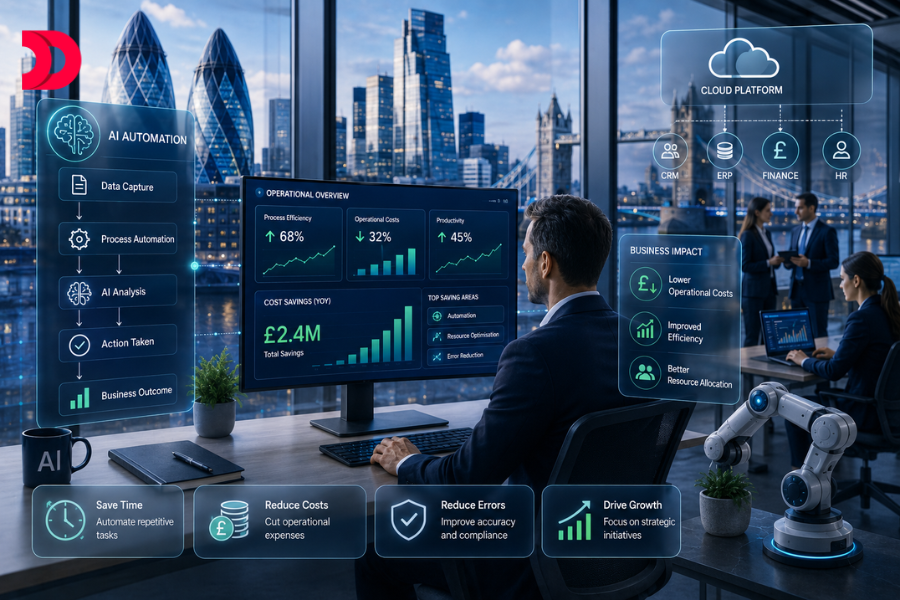
Artificial Intelligence is no longer a futuristic technology reserved for large enterprises and global corporations. Today, businesses across the United Kingdom are actively adopting AI solutions to improve efficiency, streamline operations, and reduce operational costs. From small startups and growing SMEs to established enterprises, organisations are discovering that AI can automate repetitive tasks, improve decision-making, and help teams focus on more valuable work.
With rising labour costs, increasing customer expectations, and growing market competition, UK businesses are under constant pressure to do more with fewer resources. This is where Artificial Intelligence is proving to be a game-changer. AI-powered systems can analyse large volumes of data, automate workflows, provide real-time insights, and perform tasks that previously required significant human effort.
As AI technologies continue to evolve, businesses are finding new ways to leverage them to cut expenses without compromising service quality or productivity. In this article, we explore how UK companies are using AI to reduce operational costs and why AI is becoming an essential part of modern business strategy.
The UK has become one of Europe’s leading hubs for AI innovation and adoption. Businesses across industries are investing in AI technologies to improve operational efficiency and gain a competitive advantage. Unlike traditional automation tools that follow predefined rules, modern AI systems can learn, adapt, and make intelligent decisions based on data.
Many organisations initially adopted AI to improve customer support through chatbots and virtual assistants. However, the technology has rapidly expanded into areas such as process automation, predictive analytics, supply chain management, human resources, finance, and cybersecurity.
The ability to automate complex business functions while continuously improving performance makes AI one of the most valuable investments for organisations looking to control operational expenses.
One of the most effective ways businesses reduce operational costs through AI is by automating repetitive administrative work. Many organisations spend countless hours on routine tasks such as data entry, invoice processing, document management, scheduling, and report generation.
AI-powered automation tools can perform these tasks significantly faster and with greater accuracy than manual processes. By eliminating repetitive work, businesses reduce labour costs while allowing employees to focus on strategic and revenue-generating activities.
For example, an AI-powered system can automatically process invoices, verify payment information, and update accounting records without requiring human intervention. This not only saves time but also reduces the risk of costly errors.
Companies that automate administrative workflows often experience substantial productivity improvements while lowering overall operational expenses.
Customer service departments are often one of the largest operational expenses for businesses. Hiring, training, and managing customer support teams requires significant investment. AI-powered customer service solutions are helping UK businesses address this challenge.
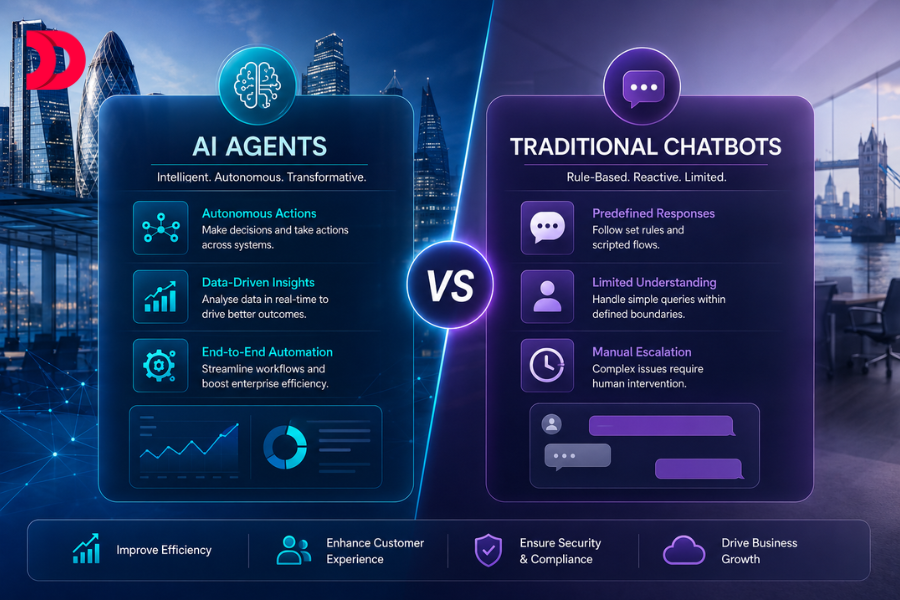
Modern AI agents can handle thousands of customer interactions simultaneously, providing instant support around the clock. Unlike traditional chatbots, AI agents understand natural language, maintain context, and resolve complex customer issues without human assistance.
These intelligent systems can answer questions, process requests, schedule appointments, track orders, and provide personalised support. As a result, businesses can significantly reduce support costs while improving customer satisfaction.
Many UK companies are using AI agents as the first line of customer support, allowing human representatives to focus on more complex and high-value interactions.
Labour costs represent a major expense for most businesses. AI helps organisations maximise productivity by enabling employees to work more efficiently and make better decisions.
AI-powered tools can assist teams by automating routine tasks, organising information, generating reports, and providing recommendations. Employees spend less time searching for information and more time focusing on strategic activities that contribute directly to business growth.
For example, sales teams can use AI to analyse customer behaviour, identify potential opportunities, and generate personalised outreach recommendations. Marketing teams can leverage AI to create content, optimise campaigns, and analyse performance data.
By improving productivity across departments, businesses achieve more output without increasing headcount, leading to significant cost savings over time.
Supply chain management is another area where AI is helping UK businesses reduce operational expenses. Inefficient inventory management, transportation delays, and forecasting errors can result in substantial financial losses.
AI-powered systems analyse historical data, market trends, and operational metrics to optimise supply chain processes. These systems can predict demand fluctuations, improve inventory management, identify potential disruptions, and optimise delivery routes.
For logistics companies, AI can reduce fuel consumption, improve route planning, and minimise transportation costs. Retail businesses can use predictive analytics to maintain optimal inventory levels and avoid overstocking or stock shortages.
By making supply chains more efficient, businesses reduce waste, improve customer satisfaction, and lower operational costs.
Financial management is critical for controlling business expenses and ensuring long-term profitability. AI is transforming how companies manage finances by providing advanced forecasting and analytical capabilities.
AI-powered financial systems can analyse spending patterns, identify cost-saving opportunities, detect anomalies, and generate accurate financial forecasts. These insights help organisations make informed decisions and allocate resources more effectively.
For example, AI can identify unnecessary expenditures, recommend budget adjustments, and predict future cash flow requirements. Financial teams can use these insights to improve planning and reduce the risk of costly mistakes.
Many UK businesses are now incorporating AI into their financial operations to gain greater visibility into expenses and improve overall financial performance.
Recruitment and employee management can be expensive and time-consuming processes. AI-powered HR solutions are helping businesses reduce hiring costs while improving recruitment outcomes.
AI can automate candidate screening, analyse resumes, schedule interviews, and identify the most suitable applicants based on predefined criteria. This significantly reduces the time and effort required for recruitment.
Additionally, AI-powered employee engagement tools can monitor workforce satisfaction, identify retention risks, and recommend strategies for improving productivity and employee experience.
By streamlining HR operations, businesses can reduce administrative costs and build stronger, more efficient teams.
Cybersecurity threats continue to increase as businesses become more reliant on digital technologies. Managing security risks manually requires substantial resources and expertise.
AI-powered cybersecurity systems can monitor networks, detect threats, and respond to suspicious activity in real time. These systems continuously analyse patterns and identify potential vulnerabilities before they become serious issues.
By automating threat detection and response, businesses can reduce the need for large security teams while improving overall protection. Preventing security breaches also helps organisations avoid costly downtime, data loss, and regulatory penalties.
AI-driven cybersecurity solutions provide both financial and operational benefits, making them a valuable investment for businesses of all sizes.
One of the most powerful advantages of AI is its ability to analyse massive amounts of data and generate actionable insights. Businesses often struggle to identify trends, anticipate market changes, and make informed decisions quickly.
Predictive analytics solutions powered by AI help organisations forecast future outcomes based on historical and real-time data. These insights enable businesses to optimise pricing strategies, improve resource allocation, predict customer behaviour, and reduce operational inefficiencies.
Better decision-making leads directly to cost savings by helping companies avoid mistakes, improve planning, and allocate resources more effectively.
Real More- Why Every App Developer Should Use AI Frameworks in 2026
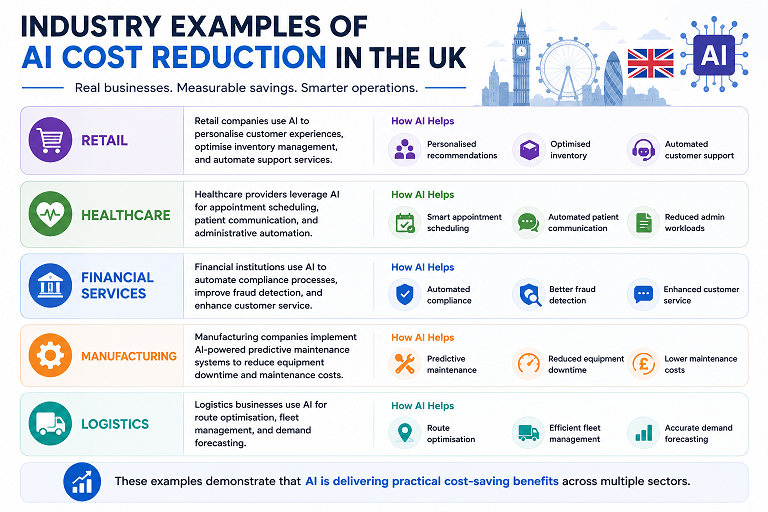
Across the UK, organisations in various industries are already experiencing measurable benefits from AI adoption.
Retail companies use AI to personalise customer experiences, optimise inventory management, and automate support services.
Healthcare providers leverage AI for appointment scheduling, patient communication, and administrative automation.
Financial institutions use AI to automate compliance processes, improve fraud detection, and enhance customer service.
Manufacturing companies implement AI-powered predictive maintenance systems to reduce equipment downtime and maintenance costs.
Logistics businesses use AI for route optimisation, fleet management, and demand forecasting.
These examples demonstrate that AI is delivering practical cost-saving benefits across multiple sectors.
While AI offers substantial advantages, successful implementation requires careful planning. Businesses should assess their objectives, data quality, existing systems, and operational requirements before investing in AI solutions.
Choosing the right AI technology and development partner is critical to achieving desired outcomes. Organisations should focus on identifying processes where automation can deliver the greatest impact and ensure employees receive appropriate training to work alongside AI systems.
A strategic approach to AI adoption helps maximise return on investment while minimising implementation risks.
The role of AI in business operations will continue to expand in the coming years. Advances in machine learning, generative AI, and autonomous systems will enable businesses to automate increasingly complex tasks and optimise operations at an unprecedented scale.
As AI technologies become more accessible, organisations that embrace innovation will gain significant advantages in efficiency, productivity, and profitability. Companies that delay adoption may struggle to compete with more agile and technology-driven competitors.
The future belongs to businesses that can effectively combine human expertise with artificial intelligence to create smarter and more efficient operations.
Artificial Intelligence is transforming how UK businesses manage costs and improve efficiency. From automating administrative work and customer support to optimising supply chains and enhancing financial management, AI is helping organisations reduce operational expenses while improving overall performance.
The ability to automate repetitive tasks, generate valuable insights, and improve decision-making makes AI one of the most impactful technologies available today. Businesses that strategically invest in AI solutions can achieve significant cost savings, improve productivity, and strengthen their competitive position.
As AI adoption continues to accelerate across the UK, organisations that embrace intelligent automation will be better equipped to navigate economic challenges and drive sustainable growth.
At DevsTree IT Solution, we help businesses harness the power of Artificial Intelligence through custom AI development services designed to improve efficiency and reduce operational costs. Our team specialises in AI agents, machine learning solutions, intelligent automation platforms, predictive analytics, and enterprise AI applications.
Whether you want to automate customer support, optimise business processes, or develop advanced AI-powered software, we deliver scalable solutions tailored to your unique business goals and operational requirements.
 James
June 10, 2026
James
June 10, 2026
Artificial intelligence is reshaping the way businesses communicate with customers,…
Read more
 James
April 14, 2026
James
April 14, 2026
Are you planning to build smarter applications that don’t just…
Read more
 James
April 8, 2026
James
April 8, 2026
Digital products are no longer just functional tools. They are…
Read more
 James
April 7, 2026
James
April 7, 2026
The enterprise landscape is evolving rapidly amidst the rise of…
Read more