

 James
James
 April 8, 2026
Digital products are no longer just functional tools. They are evolving into intelligent ecosystems that learn from user behavior, adapt in real time, and continuously improve without constant manual updates. This transformation is not just a trend, it is redefining how businesses design, build, and scale applications.
From startups to large enterprises, companies are shifting toward AI-driven architectures and automated workflows to stay competitive. The demand for intelligent, scalable, and user-centric applications is pushing development beyond traditional boundaries. Understanding this shift is essential for any business planning to build future-ready digital products.
Earlier, application development followed a linear approach. Teams defined requirements, built features, tested them, and released updates periodically. While this model worked for years, it struggled to keep up with modern user expectations.
Today’s users expect:
Traditional apps cannot meet these expectations efficiently. This is where next-gen app development comes in, focusing on systems that are dynamic, responsive, and capable of learning from data.
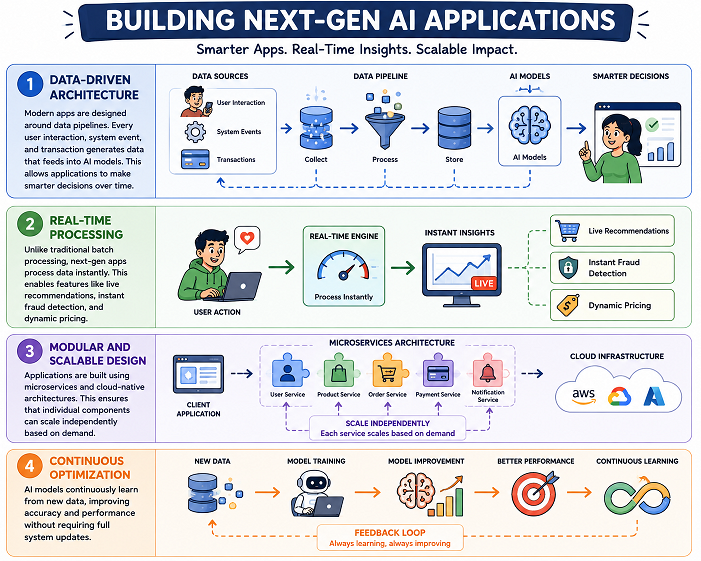
Next-gen app development is built on intelligence and automation at its core. Instead of static logic, these applications use data-driven models to evolve continuously.
Core characteristics explained in depth:
Artificial Intelligence is the backbone of next-generation digital products. It transforms applications from rule-based systems into intelligent platforms capable of reasoning and learning.
Key AI components in detail:
Machine Learning Models
These models analyze historical and real-time data to identify patterns. For example, an e-commerce app can predict what a user is likely to purchase next based on past behavior.
Natural Language Processing (NLP)
NLP allows applications to understand and respond to human language. This powers chatbots, virtual assistants, and voice-enabled interfaces.
Computer Vision
Used in applications that process images or videos, such as facial recognition, medical imaging, and security systems.
Recommendation Systems
These systems personalize user experiences by suggesting relevant content, products, or actions based on user preferences.
Businesses aiming to build intelligent systems often hire AI developer experts who understand how to design, train, and deploy these models effectively.
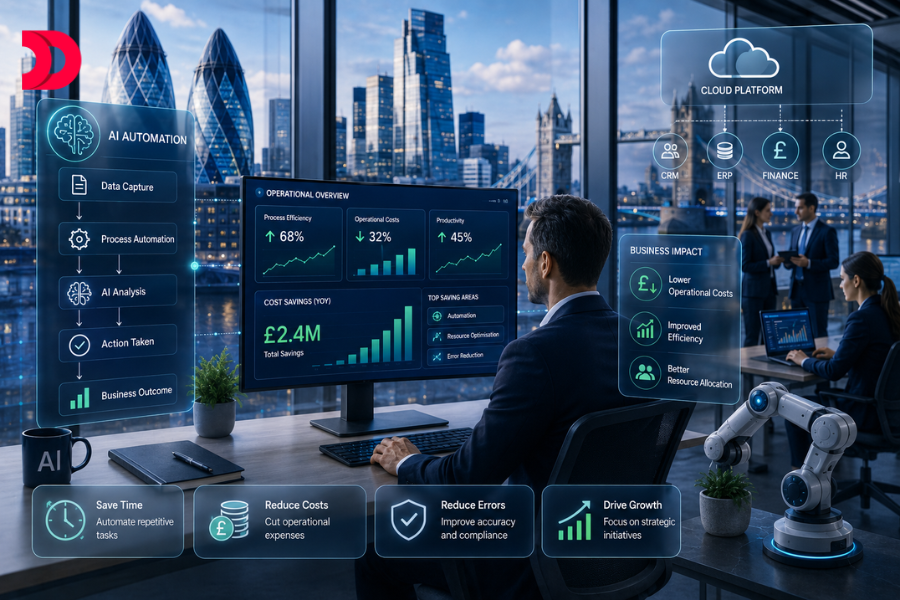
Automation is not limited to one stage of development. It is integrated across the entire lifecycle, making processes faster, more reliable, and less dependent on manual effort.
In-depth look at automation stages:
The integration of AI and automation delivers significant business value beyond just technical improvements.
Detailed benefits:
Operational Efficiency
Automation reduces repetitive tasks, allowing teams to focus on strategic activities.
Cost Reduction
By minimizing manual effort and optimizing resource usage, businesses can lower operational costs.
Improved Decision-Making
AI provides real-time insights, enabling faster and more accurate decisions.
Enhanced Customer Experience
Personalized interactions and faster responses improve user satisfaction and retention.
Scalability and Flexibility
Cloud-based architectures and automation allow businesses to scale without major infrastructure changes.
Working with a reliable AI app development company ensures these benefits are implemented with the right strategy and technical expertise.
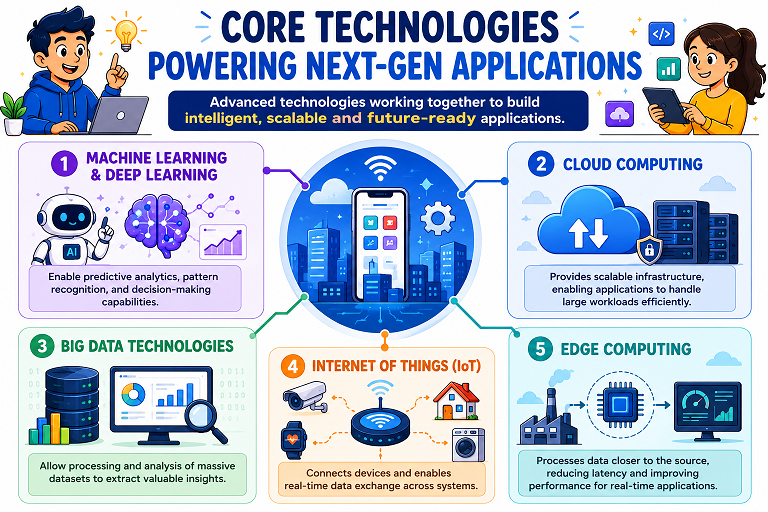
Next-gen app development is supported by a combination of advanced technologies that work together to create intelligent systems.
Detailed breakdown:
Machine Learning and Deep Learning
Enable predictive analytics, pattern recognition, and decision-making capabilities.
Cloud Computing
Provides scalable infrastructure, enabling applications to handle large workloads efficiently.
Big Data Technologies
Allow processing and analysis of massive datasets to extract valuable insights.
Internet of Things (IoT)
Connects devices and enables real-time data exchange across systems.
Edge Computing
Processes data closer to the source, reducing latency and improving performance for real-time applications.
AI and automation are transforming industries by enabling smarter and more efficient applications.
Healthcare
AI-powered systems assist in diagnostics, patient monitoring, and predictive healthcare, improving outcomes and reducing costs.
Finance
Applications use AI for fraud detection, risk analysis, and automated financial services, ensuring security and efficiency.
E-commerce
Personalized recommendations, chatbots, and automated inventory systems enhance customer experience and operational efficiency.
Real Estate
AI-driven platforms provide property recommendations, market insights, and virtual tours, improving decision-making for buyers and sellers.
Manufacturing
Predictive maintenance and automated production systems reduce downtime and improve efficiency.
Despite its advantages, next-gen app development comes with challenges that businesses must address carefully.
Key challenges explained:
Data Privacy and Security
Handling sensitive data requires strict compliance with regulations and robust security measures.
Integration with Legacy Systems
Existing systems may not be compatible with AI-driven architectures, requiring careful planning.
High Initial Investment
Developing intelligent systems can require significant upfront investment.
Skill Gap
There is a shortage of professionals with expertise in AI, data science, and automation.
Continuous Model Maintenance
AI models need regular updates to maintain accuracy and performance.
The future of app development will be defined by deeper integration of intelligence and automation.
Detailed trends:
Agent-Based Systems
Applications capable of performing tasks independently without human intervention.
Hyper-Personalization
Real-time customization based on user behavior, preferences, and context.
Low-Code and No-Code Development
Simplifying development processes and enabling faster product delivery.
AI-Driven User Interfaces
Dynamic interfaces that adapt based on user interactions and preferences.
Autonomous Systems
Applications that operate independently, requiring minimal human oversight.
To succeed in next-gen app development, businesses need a clear and structured approach.
Key strategic steps:
Businesses that choose to hire AI developer professionals or partner with experienced teams can accelerate this transformation effectively.
Next-gen app development is transforming digital products into intelligent, adaptive, and scalable systems. AI and automation are no longer optional but essential for building applications that meet modern user expectations.
As technology continues to evolve, businesses that embrace this shift will gain a strong competitive advantage. The future belongs to organizations that can combine intelligence, automation, and innovation to create products that continuously learn and improve.
Building such systems requires the right strategy, tools, and expertise, but the long-term value they deliver makes the investment worthwhile.
 James
June 12, 2026
James
June 12, 2026
Artificial Intelligence is no longer a futuristic technology reserved for…
Read more
 James
June 10, 2026
James
June 10, 2026
Artificial intelligence is reshaping the way businesses communicate with customers,…
Read more
 James
April 14, 2026
James
April 14, 2026
Are you planning to build smarter applications that don’t just…
Read more
 James
April 7, 2026
James
April 7, 2026
The enterprise landscape is evolving rapidly amidst the rise of…
Read more