

 James
James
 February 5, 2026
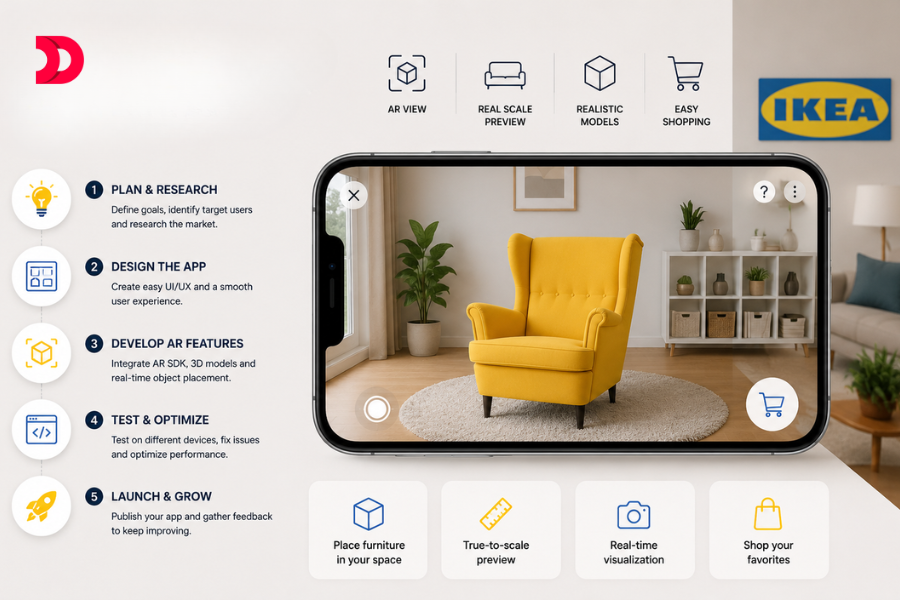
The furniture shopping experience has changed dramatically over the past few years. Customers no longer want to rely solely on product images or showroom visits before making a purchase. Instead, they expect immersive shopping experiences that allow them to visualize furniture in their own homes before placing an order. This is where Augmented Reality (AR) has become a game changer.
Apps like IKEA Place have demonstrated how AR technology can improve customer confidence, reduce product returns, and increase online sales. If you’re planning to build a similar solution, partnering with an experienced AR application development company can help you create a feature rich, scalable, and user friendly application.
This guide explains everything you need to know about building an AR furniture application, including essential features, development process, technology stack, business benefits, and IKEA app development cost considerations.
Buying furniture online can be challenging because customers often struggle to understand how a product will fit within their available space. Augmented Reality solves this problem by allowing users to place virtual furniture inside real environments using their smartphone cameras.
This interactive shopping experience helps customers make informed purchasing decisions while giving furniture retailers a competitive advantage. Businesses working with a trusted Furniture app development company can create applications that improve customer engagement and increase online conversions.
Some of the biggest benefits include:
An AR furniture app allows customers to visualize sofas, tables, chairs, beds, cabinets, and other furniture items inside their own homes using Augmented Reality technology. Users simply point their smartphone camera at a room, select a product, and instantly see a life sized digital model placed within the space.
Modern applications also include product customization, room measurements, shopping carts, secure payments, and order tracking, making them complete furniture shopping platforms.
Partnering with a reliable Furniture e-commerce development company ensures these advanced features are integrated seamlessly.
A successful furniture application requires more than AR visualization. It should deliver a complete shopping experience that is intuitive, secure, and engaging for users.
Important customer features include:
These features create a convenient shopping journey while encouraging repeat purchases.
Augmented Reality is the heart of a furniture visualization app. Modern AR capabilities make online shopping far more interactive than traditional ecommerce websites.
Popular AR features include:
Real Time Furniture Placement
Customers can place furniture anywhere inside their room using their smartphone camera.
Accurate Size Scaling
Products appear in their actual dimensions, helping users understand how they fit within available space.
Multiple Viewing Angles
Customers can walk around the virtual furniture to inspect it from different perspectives.
Color and Material Customization
Users can change upholstery, wood finishes, and colors before purchasing.
Lighting Adjustment
The application adapts virtual furniture to match the room’s lighting conditions, creating a realistic appearance.
These capabilities significantly improve buyer confidence before checkout.
Developing an AR powered furniture application requires careful planning, technical expertise, and a clear understanding of customer expectations.
Step 1: Market Research
Study competitors, customer preferences, and current industry trends before defining your application requirements.
Research should include:
A well researched strategy lays the foundation for a successful application.
Step 2: Define Features
Create a detailed feature list based on your business goals and customer expectations.
Typical modules include:
An experienced Ecommerce App Development Company can help prioritize features for your Minimum Viable Product (MVP).
Step 3: Design the User Experience
The interface should be clean, intuitive, and easy to navigate. Customers should be able to search products, activate AR mode, customize furniture, and complete purchases without confusion.
A user friendly design increases engagement while reducing abandoned shopping carts.
Step 4: Develop the Application
Developers build the frontend, backend, AR engine, APIs, cloud infrastructure, and ecommerce functionality required for the platform.
Businesses often partner with a professional Mobile App Development Company to ensure smooth integration across every component.
Step 5: Test the Application
Comprehensive testing ensures reliable performance before launch.
Testing includes:
Thorough testing minimizes bugs and improves customer satisfaction.
Step 6: Launch and Improve
After launch, businesses should monitor customer feedback, analyze user behavior, and release regular updates with new features and furniture collections.
Continuous improvement helps maintain long term competitiveness.
Selecting the right technology stack is essential for creating a scalable and high performing application.
Popular technologies include:
Mobile Development
AR Technologies
Backend
Database
Cloud Platforms
Choosing the right technologies depends on your project requirements and expected user traffic.
An AR furniture application should function as a complete online shopping platform rather than only an AR viewer. Strong ecommerce functionality simplifies purchasing while improving customer retention.
Essential ecommerce features include:
A trusted Furniture e-commerce development company understands how to combine AR technology with modern ecommerce capabilities.
Many businesses are now combining Artificial Intelligence with AR to create even smarter shopping experiences.
AI powered features include:
These features improve customer engagement while increasing conversion rates.
One of the most common questions businesses ask is about IKEA app development cost. The overall investment depends on the complexity of the application, required features, supported platforms, and development timeline.
Major cost factors include:
A basic AR furniture application typically requires a lower investment than a large scale marketplace featuring advanced personalization, AI recommendations, multiple vendors, and enterprise level infrastructure.
Consulting a professional Furniture app development company provides a more accurate estimate based on your project scope.
Developing an AR furniture application requires expertise across multiple technologies, including mobile development, ecommerce systems, AR frameworks, cloud computing, and cybersecurity.
Businesses that Hire Ecommerce App Developers gain access to specialists who understand every stage of application development.
Professional developers offer:
Working with experienced developers reduces project risks while accelerating time to market.
Selecting the right technology partner is one of the most important decisions for your project. Beyond technical expertise, your development company should understand furniture retail, ecommerce workflows, and AR technologies.
When evaluating an AR application development company, consider:
A reliable Mobile App Development Company will also help you scale your platform as your business grows.
The future of furniture shopping will continue to evolve through emerging technologies that create even more immersive buying experiences.
Upcoming trends include:
Businesses that adopt these innovations early will gain a significant competitive advantage.
Augmented Reality is transforming the furniture industry by making online shopping more interactive, accurate, and enjoyable. Customers can visualize products inside their homes, compare different furniture styles, and make confident purchasing decisions without visiting a physical showroom.
If you want to build an application like IKEA Place, partnering with an experienced AR application development company is the first step toward success. A trusted Ecommerce App Development Company or Furniture e-commerce development company can help you create a secure and scalable solution that combines immersive AR experiences with powerful ecommerce functionality. Whether you’re looking to understand IKEA app development cost, Hire Ecommerce App Developers, or work with a leading Furniture app development company, investing in the right technology and development expertise will position your business for long term success in the rapidly growing digital furniture market.
 James
July 8, 2026
James
July 8, 2026
The eCommerce industry has evolved far beyond traditional online shopping.…
Read more
 James
March 11, 2026
James
March 11, 2026
Virtual Reality (VR) is transforming the way people interact with…
Read more
 James
November 3, 2025
James
November 3, 2025
AI virtual assistants are revolutionizing how users engage with web…
Read more
 James
March 4, 2025
James
March 4, 2025
Businesses are always looking for new ways to engage customers…
Read more