

 James
James
 June 10, 2026
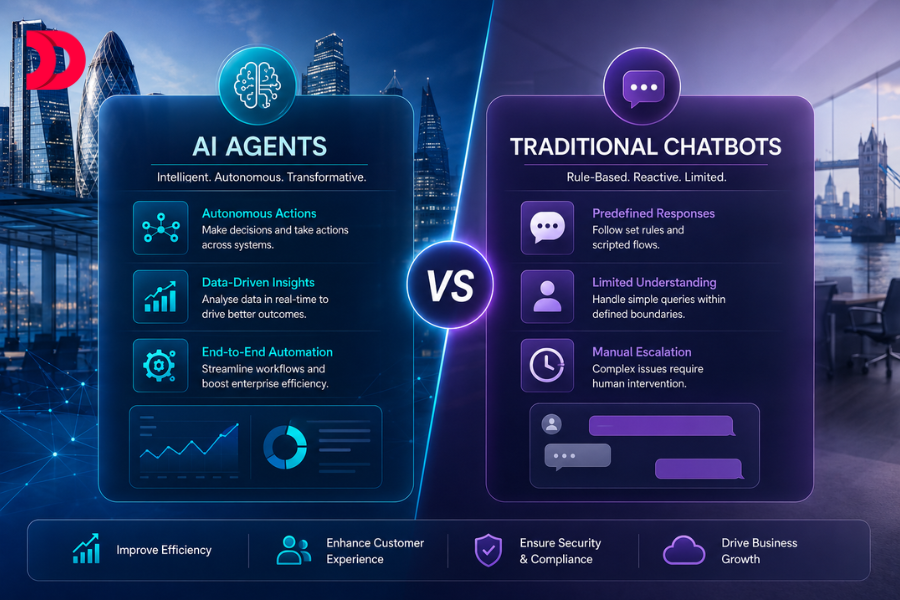
Artificial intelligence is reshaping the way businesses communicate with customers, manage operations, and drive growth. Across the UK, organisations are investing heavily in AI-powered technologies to improve customer experiences, reduce operational costs, and gain a competitive advantage. One of the most common questions business leaders face today is whether they should implement a traditional chatbot or invest in an advanced AI agent.
At first glance, both technologies may appear similar because they interact with users through conversations. However, the capabilities, intelligence, and business impact of AI agents and traditional chatbots are significantly different. While chatbots have been helping businesses automate basic customer interactions for years, AI agents represent a new generation of intelligent systems capable of understanding context, making decisions, and performing complex tasks autonomously.
For UK companies looking to modernise their digital operations, understanding the differences between these technologies is essential. Choosing the wrong solution can lead to limited functionality, poor customer experiences, and missed business opportunities. In this guide, we explore the key differences between AI agents and traditional chatbots and help you determine which option is best suited for your business needs.
Traditional chatbots have become a familiar feature across business websites, mobile applications, and customer support platforms. These systems are designed to automate repetitive conversations using predefined rules, scripted workflows, and keyword-based responses. Before investing in advanced AI solutions, many businesses start with basic chatbot automation developed by an experienced AI Chatbot Development Company.
For example, if a customer asks about delivery times, a traditional chatbot scans for relevant keywords and returns a pre-programmed response. When customer queries closely match the chatbot’s knowledge base, interactions are fast and efficient. However, if users ask more complex or unexpected questions, traditional chatbots often struggle to understand the context or provide accurate answers.
Traditional chatbots are well suited for handling frequently asked questions, appointment scheduling, order tracking, account information, and other routine customer service tasks. Since they rely on predefined rules instead of artificial intelligence, they are relatively quick to develop, cost effective to implement, and easy to maintain. Businesses looking to automate basic customer support often choose to hire chatbot developer professionals to build these solutions according to their operational needs.
Although traditional chatbots improve efficiency by reducing manual support requests, they have limited capabilities when conversations become more dynamic or personalised. They cannot understand user intent, remember previous interactions, or adapt their responses based on context.
As customer expectations continue to evolve, businesses increasingly require intelligent virtual assistants that can deliver personalised, context aware, and human like conversations. This growing demand has encouraged organisations to partner with an experienced AI Chatbot Development Company to build advanced AI powered chatbots capable of understanding natural language, learning from interactions, and delivering a significantly better customer experience.
AI agents are a significant advancement in conversational technology. Unlike traditional chatbots, AI agents are powered by advanced technologies such as Large Language Models (LLMs), Machine Learning, Natural Language Processing (NLP), and Generative AI. These technologies enable AI agents to understand context, learn from interactions, reason through complex problems, and perform tasks independently.
Rather than simply responding to questions, AI agents can actively complete actions, analyse information, and make intelligent decisions. They are capable of maintaining context throughout a conversation, understanding user intent, and adapting responses based on previous interactions.
For example, if a customer contacts an AI agent and asks to update their account details, change a delivery date, and receive a payment confirmation, the AI agent can perform all these tasks within a single conversation. It can access connected systems, retrieve data, execute actions, and provide real-time updates without requiring human intervention.
This level of intelligence makes AI agents particularly valuable for businesses looking to automate complex workflows and provide exceptional customer experiences.
The primary difference between AI agents and traditional chatbots lies in their ability to understand and act on information. Traditional chatbots are reactive. They wait for specific questions and provide predetermined responses. AI agents, on the other hand, are proactive and capable of understanding broader objectives.
A chatbot can answer a question about business hours, but an AI agent can schedule appointments, update records, send reminders, and handle follow-up actions. While chatbots rely on fixed conversation flows, AI agents dynamically generate responses based on context and intent.
Another major distinction is personalization. Traditional chatbots typically provide the same responses to every user regardless of their history or preferences. AI agents can analyse user behaviour, previous interactions, and customer data to deliver highly personalised experiences that feel more natural and relevant.
Integration capabilities also differ significantly. Traditional chatbots often operate as standalone tools with limited access to business systems. AI agents can integrate with customer relationship management platforms, enterprise resource planning systems, databases, payment gateways, and other software applications to perform meaningful business functions.
Read more- Building AI-Native Applications: The Role of Agents, Generative AI & Live Intelligence
Although AI agents are gaining popularity, traditional chatbots continue to offer value in specific situations. For businesses with straightforward customer service requirements, chatbots can provide an affordable and efficient solution.
Many small businesses use chatbots to answer common questions, provide business information, and assist website visitors. Because these chatbots follow predefined workflows, they can be implemented quickly and require relatively little maintenance.
Traditional chatbots are also suitable for organisations that want to test automation before investing in more sophisticated AI technologies. They provide an entry point into conversational automation and can improve response times for basic customer inquiries.
However, businesses should recognise that traditional chatbots have limitations. As customer interactions become more complex, maintaining large decision trees becomes increasingly difficult. This often results in frustrating user experiences and frequent escalations to human agents.
AI agents are becoming increasingly popular among UK companies because they deliver significantly greater business value. Rather than simply reducing workload, AI agents have the potential to transform entire business processes.
Customer service is one of the most obvious examples. AI agents can handle thousands of customer interactions simultaneously while providing accurate, personalised, and context-aware responses. This improves customer satisfaction while reducing support costs. Beyond customer service, AI agents can automate administrative tasks, assist employees, generate reports, analyse business data, and manage workflows. They act as intelligent digital workers capable of supporting multiple departments across an organisation.
For example, an AI agent in a financial services company can help customers understand products, process loan applications, verify information, and provide personalised recommendations. In healthcare, AI agents can assist patients with appointment scheduling, symptom assessment, and follow-up communication. The ability to automate complex tasks while maintaining high-quality interactions is one of the primary reasons AI agents are becoming a strategic investment for forward-thinking organisations.
The adoption of AI agents is growing rapidly across multiple industries in the United Kingdom. Financial institutions are using AI agents to improve customer service, automate compliance processes, and enhance fraud detection. Retail businesses are leveraging AI-powered assistants to provide personalised product recommendations and streamline customer support.
Healthcare organisations are implementing AI agents to improve patient engagement and administrative efficiency. Logistics companies are using AI systems to manage deliveries, track shipments, and optimise supply chain operations. Even sectors such as real estate, education, and professional services are finding innovative ways to use AI agents to improve productivity and enhance customer experiences. As the technology continues to mature, businesses across all industries are discovering new opportunities to leverage AI-powered automation.
The decision between an AI agent and a traditional chatbot depends on your business goals, customer expectations, and operational requirements.
If your business primarily needs to answer simple customer questions and automate repetitive interactions, a traditional chatbot may be sufficient. It offers a lower initial investment and can be implemented relatively quickly. However, if your organisation handles complex customer journeys, requires system integrations, or wants to automate business processes, an AI agent is likely the better investment. Although AI agents require a larger upfront investment, they provide greater scalability, flexibility, and long-term value.
Many businesses that initially deploy traditional chatbots eventually upgrade to AI agents as their requirements evolve. Investing in AI from the beginning can often eliminate future limitations and create a stronger foundation for growth.
The future of business automation is moving far beyond simple chat interfaces. AI agents are rapidly evolving into intelligent digital assistants capable of performing increasingly sophisticated tasks. As AI technology advances, businesses will be able to automate more processes, deliver more personalised experiences, and operate with greater efficiency.
UK companies are already embracing AI as part of their digital transformation strategies. Organisations that invest in advanced AI capabilities today will be better positioned to compete in tomorrow’s marketplace. The shift from rule-based chatbots to intelligent AI agents is not simply a technology upgrade; it represents a fundamental change in how businesses interact with customers and manage operations.
Both traditional chatbots and AI agents have important roles to play in modern business environments. Traditional chatbots remain useful for handling simple interactions and providing basic automation. However, businesses seeking greater efficiency, enhanced customer experiences, and intelligent workflow automation are increasingly turning to AI agents.
For UK companies focused on long-term growth and innovation, AI agents offer significantly more value. Their ability to understand context, automate complex tasks, integrate with business systems, and deliver personalised experiences makes them a powerful tool for digital transformation.
As customer expectations continue to rise and competition intensifies, investing in advanced AI solutions can help businesses improve operational efficiency, strengthen customer relationships, and achieve sustainable growth in an increasingly digital world.
At DevsTree, we help UK businesses harness the power of artificial intelligence through custom AI agent development services. Our team specialises in building intelligent AI solutions that automate workflows, enhance customer engagement, and drive measurable business outcomes.
Whether you need an AI-powered customer support agent, enterprise automation solution, virtual assistant, or industry-specific AI platform, we deliver scalable and secure solutions tailored to your unique business requirements.
 James
June 12, 2026
James
June 12, 2026
Artificial Intelligence is no longer a futuristic technology reserved for…
Read more
 James
April 14, 2026
James
April 14, 2026
Are you planning to build smarter applications that don’t just…
Read more
 James
April 8, 2026
James
April 8, 2026
Digital products are no longer just functional tools. They are…
Read more
 James
April 7, 2026
James
April 7, 2026
The enterprise landscape is evolving rapidly amidst the rise of…
Read more