

 James
James
 April 14, 2026
Are you planning to build smarter applications that don’t just work but actually think, adapt, and respond in real time?
Then you’re already looking in the right direction.
AI-native applications are no longer a future concept. They are becoming a business necessity. From automation to personalization, companies are now moving toward systems that can understand data, make decisions, and continuously improve.
And the core of this transformation revolves around three key elements: AI agents, generative AI, and live intelligence.
In this guide, you’ll understand how these components work together and what it actually takes to build AI-native applications.
AI-native applications are built with intelligence at their core.
Unlike traditional apps that rely on fixed workflows, these systems use data, context, and learning models to adapt in real time. They don’t just execute commands, they understand intent and respond accordingly.
This shift is happening because businesses now want faster decisions, better personalization, and systems that can scale with complexity.
The demand for AI-native systems is growing rapidly, and there are clear reasons behind it.
Modern applications need to do more than just function. They need to think, learn, and improve continuously.
To build a truly intelligent application, you need to understand the core components behind it.
AI agents are responsible for decision-making and execution.
They can analyze data, take actions, and automate workflows without constant human input. Instead of just assisting, they actively perform tasks and optimize outcomes over time.
Generative AI enables applications to create content, responses, and interactions dynamically.
It helps systems understand user queries, generate meaningful outputs, and deliver personalized experiences instead of fixed responses.
Live intelligence ensures that applications operate on real-time data.
It allows systems to respond instantly, update decisions dynamically, and stay aligned with current conditions rather than relying on outdated information.
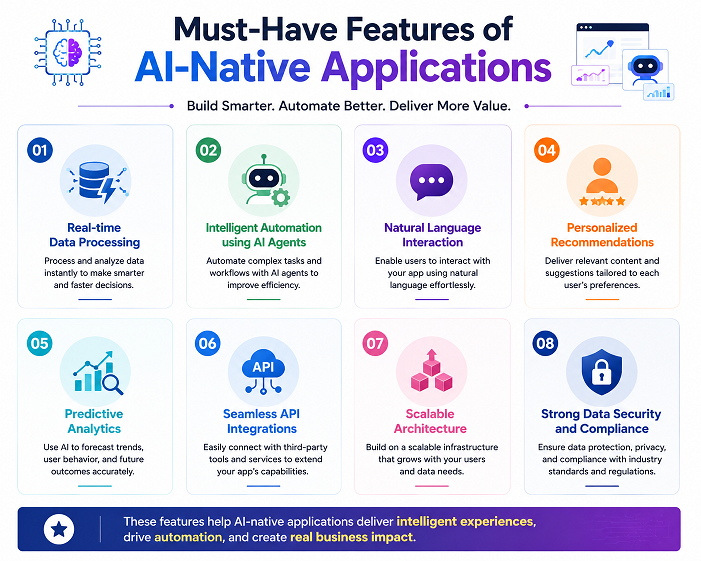
If you want to build a competitive AI-native application, these are the essential features you should include:
These features help applications move from basic functionality to intelligent performance.
Building AI-native applications requires a structured approach. Here’s how the process typically works.
Start by identifying where AI can create real value.
Focus on areas where decisions can be improved, processes can be automated, or user experience can be enhanced.
Data is the foundation of any AI system.
Clean, structured, and relevant data is essential for training models and ensuring accurate results.
Depending on your use case, you may need machine learning models, large language models, or custom AI solutions.
Choosing the right model directly impacts performance.
AI-native applications require scalable and flexible architecture.
This includes backend systems, APIs, data pipelines, and real-time processing capabilities.
This is where everything comes together.
AI agents, generative AI models, and real-time data systems are integrated into the application.
AI systems need continuous testing.
You need to monitor performance, improve accuracy, and optimize workflows based on real usage.
After launch, the work doesn’t stop.
AI-native applications evolve over time, improving through data, feedback, and updates.
Read More- How UK Businesses Are Using AI to Reduce Operational Costs
Choosing the right tech stack is critical for performance and scalability.
Here are commonly used technologies:
The right combination depends on your project requirements and scale.
The cost of AI-native application development depends on several factors.
Here’s a rough estimate:
| Application Type | Estimated Cost | Timeline |
| Basic AI App | $10,000 – $25,000 | 2–4 Months |
| Mid-Level AI App | $25,000 – $60,000 | 4–8 Months |
| Advanced AI System | $60,000+ | 8+ Months |
As seen in similar development models, costs increase with complexity, features, and scalability requirements.
While the opportunities are huge, there are also challenges.
That’s why having the right development approach and expertise matters.
AI-native applications are not just an upgrade to traditional systems. They represent a complete shift in how software is built and experienced. By combining AI agents, generative AI, and live intelligence, businesses can create systems that are faster, smarter, and more adaptive. And as technology continues to evolve, this approach will become the standard for modern application development.
The cost depends on complexity, features, and integrations. Basic applications cost less, while advanced systems with real-time intelligence require higher investment.
A basic version can take a few months, while complex systems may take 6–10 months depending on requirements.
Industries like healthcare, finance, eCommerce, SaaS, and recruitment can benefit the most due to high data usage and decision-making needs.
Yes, if built correctly. Security measures like encryption, authentication, and compliance protocols help protect user data.
Yes, scalability is one of their biggest advantages. They are designed to grow with data, users, and business needs.
 James
June 12, 2026
James
June 12, 2026
Artificial Intelligence is no longer a futuristic technology reserved for…
Read more
 James
June 10, 2026
James
June 10, 2026
Artificial intelligence is reshaping the way businesses communicate with customers,…
Read more
 James
April 8, 2026
James
April 8, 2026
Digital products are no longer just functional tools. They are…
Read more
 James
April 7, 2026
James
April 7, 2026
The enterprise landscape is evolving rapidly amidst the rise of…
Read more