Chat on WhatsApp

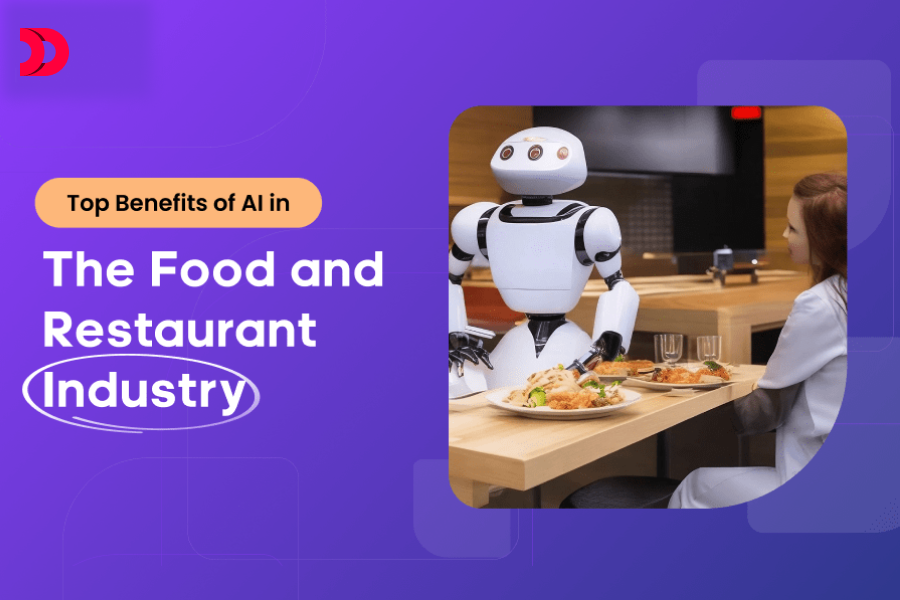
Top Benefits of AI in the Food & Restaurant Industry

In recent years, the integration of Artificial Intelligence (AI) has revolutionized various sectors, and the food and restaurant industry is no exception. From streamlining operations to enhancing customer experiences, AI offers a plethora of benefits for businesses in this domain. In this blog post, we’ll delve into the advantages that AI brings to the table in the food and restaurant industry.

Enhanced Efficiency and Accuracy

AI-powered systems can automate repetitive tasks, such as order processing, inventory management, and customer service inquiries. By leveraging machine learning algorithms, restaurants can optimize their operations, leading to increased efficiency and accuracy in tasks like food preparation, inventory tracking, and order fulfilment.

Personalized Customer Experiences

One of the key advantages of AI in the food and restaurant industry is its ability to analyze customer data and preferences to offer personalized recommendations. From suggesting menu items based on past orders to tailoring promotions and discounts, AI algorithms can help restaurants deliver a more personalized and engaging experience to their customers.

Predictive Analytics for Demand Forecasting

AI algorithms can analyze various factors such as historical sales data, seasonal trends, weather patterns, and local events to predict future demand accurately. By leveraging predictive analytics, restaurants can optimize their inventory management, reduce food wastage, and ensure that they have the right amount of ingredients on hand to meet customer demand.

Improved Food Quality and Safety

AI-powered systems can monitor various aspects of food production and storage to ensure compliance with safety standards and regulations. From detecting contaminants in ingredients to monitoring food temperatures during storage and transportation, AI technologies can help restaurants maintain high standards of food quality and safety.

Streamlined Food Delivery Operations

For food delivery businesses, AI can play a crucial role in optimizing delivery routes, predicting delivery times, and managing driver schedules. By leveraging AI algorithms, food delivery companies can streamline their operations, reduce delivery times, and enhance the overall customer experience.

Conclusion

In conclusion, the integration of AI offers numerous benefits for businesses in the food and restaurant industry, ranging from enhanced efficiency and accuracy to personalized customer experiences and improved food quality and safety. By embracing AI technologies, food businesses can stay ahead of the curve and provide better services to their customers in today’s competitive landscape.

For food delivery app development, On-demand app development solutions, building your own food ordering app, food delivery website development, or POS software development, reach out to Devstree UK, a leading provider of innovative technology solutions for the food and restaurant industry.

Stay tuned for more insightful articles on how technology is shaping the future of the food and restaurant industry!

How to Build Video Chat App – Types, Features, Cost

Nowadays, video chat applications have entered not only personal but also professional communications. Whether you want to develop your custom video chat app, gaining insight into how it works will help create an efficient and capable product. Herein, you will learn about the crucial types, features, and costs involved in the development of a video chat app from scratch.

Types of Video Chat Apps:

According to the target audience and purpose, while developing a video chat app, there are several types: one-to-one, group, or conference. Each has its characteristics, which have to be taken into consideration.

One-to-One Video Chat App

This is the simplest form, having two users connected over video. It’s highly suitable for personal communication apps that may want to ensure easy face-to-face conversation, like FaceTime or Google Duo.

Group Video Chat App

Group conversations allow multiple users to connect at once. These are perfect for business meetings or just virtual hanging out. The best-known tools are Zoom and Microsoft Teams.

Live Streaming and Webinars

On the event, webinar, or live streaming to a large group, these one-way streaming platforms, like Twitch or YouTube Live, serve thousands with a single main presenter.

Hybrid Models

A few apps seamlessly integrate video chatting into text/messaging apps: Facebook Messenger and WhatsApp.

Key Features for Your Video Chat App

  • The success of a video chat application will be pegged on the features it provides. Below are some functionalities you wouldn’t want to miss around:
  • User Registration & Authentication: Secure log-in using email, social media, or phone numbers.
  • Real-Time Video and Audio Streaming: Quality is key for audio and video. Using WebRTC (Web Real-Time Communication) can provide seamless media transfer.
  • Text Messaging: Adding messaging capabilities can enhance user experience.
  • Screen Sharing & File Sharing: A must-have feature for business and educational use.
  • Push Notifications: Let users know about new messages, video calls, or events.
  • End-to-End Encryption: Let users’ conversations be secure: crucial in today’s increasingly privacy-sensitive applications.
  • Virtual Background & Filters: Fun feature, useful in professional settings or personally.
  • Cross-Platform Compatibility: Ensure it will work seamlessly across Android, iOS, and web platforms.

How to Build Your Own Custom Video Chat Application: Step-by-Step

Planning and Market Research

Do your market research first before trying to develop a video chat app. Understand the needs of your target audience and look for breaches in the market.

Select Technology Stack:

  • Frontend: React Native, Flutter, or Swift for mobile.
  • Backend: Node.js, Python, or Ruby would be perfect for scalability.
  • Database: MongoDB and Firebase work great when it comes to handling real-time data.
  • WebRTC: It is the common framework used nowadays to manage real-time video and audio.

UI/UX Design

Keep it simple yet workable: neat, intuitive design means seamless operation of your app.

Build & Test

Start developing the main features and audio streaming, for example, build out all the other features. Do some serious testing after each step in development.

Launch & Iterate

Get feedback from users once it’s live, and update your app regularly to squash bugs or push new features.

Cost to Build a Video Chat App:

The cost of developing a video chat application depends on various factors. Factors include the complexity of features you need to develop, the location of your development team, and whether you are building apps from scratch for a single platform or all platforms: iOS, Android, and web.

  • Simple One-on-One Chat Application: An application with general features can range between $30,000 and $50,000.
  • Video Group Chat App: With extra features such as group chats and integrations, the amount will go up to around $50,000 to $100,000 contingent on the complexity. 
  • Enterprise-Level Application (Zoom Alternative): For applications that feature screen sharing, encryption, and more scalability, the cost can rise to the tune of $150,000 and above.

In the process, it is highly necessary to hire a professional team of expert developers to ensure quality and long-term success. If you want to hire app developers, associating with a responsible mobile app development company cuts your budget considerably without making any compromise with the performance. 

Conclusion: Developing Your Video Chat App

Building a video chat application requires the right features and technical know-how for proper construction. In this modern era, remote communication has made it very important to have an app robust and scalable enough to suit business or personal purposes. Whatever the need its basic features or a high-end partner with the right team can make a difference.

If you are ready to build your custom video chat app, then reach out to a trusted app development company. A company like Devstree UK can help you with the years of experience that they have in mobile app development.

Want to get started? Hire app developers from one of the best mobile app development companies today!

What is the Advantage in Banking and Finance of Using AI?

Introduction: In recent years, the field of banking and finance has undergone a significant transformation, largely due to the integration of Banks’ artificial intelligence (AI) technology. AI for Finance Industry has revolutionised the way financial institutions operate by providing them with the ability to analyse and process vast amounts of data quickly and accurately. With the help of AI, banks can streamline their operations, detect fraudulent activities, improve customer experience, and make informed decisions. In this blog, we will explore the advantages of using Artificial Intelligence in banking and finance and understand how this technology transforms the financial sector. We will delve into the applications of AI in banking, the benefits it offers, and the challenges faced by financial institutions in adopting this technology. Whether you are a banker, investor, or curious reader interested in understanding the future of the financial industry, this blog will provide you with an insightful overview of the advantages of using Artificial Intelligence in Finance and Banking.

Benefits of AI in Banking and Finance:

Fraud Detection and Prevention:

One of the most significant advantages of Artificial Intelligence in Finance and Banking is its ability to detect and prevent fraudulent activities. Banks use AI-powered fraud detection tools to identify suspicious transactions and prevent fraudulent activities before they occur. With AI, banks can analyze vast amounts of data, including customer behaviour, transaction history, and social media activity, to detect and prevent fraud.

Enhanced Customer Experience:

AI-powered chatbots can assist customers with their banking needs, answer queries, and provide personalized recommendations. AI chatbots can also analyze customer interactions and provide banks with valuable insights into customer behaviour, enabling them to provide a more personalized experience.

Streamlined Operations:

AI technology is also transforming banking operations by automating routine tasks, such as data entry and report generation. With AI, banks can process vast amounts of data quickly and accurately, reducing the risk of errors and enabling banks to make more informed decisions.

Improved Decision-Making:

AI-powered analytics tools provide banks with valuable insights into customer behaviour, market trends, and risk management. This information can help banks make more informed decisions and develop more effective strategies.

Challenges of AI in Banking and Finance:

While the benefits of Artificial Intelligence in Finance and Bankingare numerous, there are also several challenges that banks and financial institutions must overcome when adopting this technology. One of the primary challenges is the need for skilled professionals who can manage and operate AI systems. Banks must invest in training their employees and hiring skilled professionals to manage AI technologyAnother issue is the requirement for data security and privacy. Banks and financial institutions must ensure that customer data is secure and that AI systems comply with data protection regulations.

AI Applications in Banking and Finance:

Artificial Intelligence (AI) has transformed the banking and finance industry in numerous ways. AI technology is being used by banks and financial institutions to automate routine tasks, enhance customer experience, and improve decision-making. Let’s explore some of the most common applications of Artificial Intelligence in Finance and Banking.

Fraud Detection and Prevention:

AI-powered fraud detection tools can analyze vast amounts of data, including transaction history, customer behaviour, and social media activity, to identify suspicious transactions and prevent fraudulent activities before they occur. This helps banks to minimize losses due to fraud and maintain customer trust.

Chatbots for Customer Service:

AI-powered chatbots are becoming increasingly popular in the banking industry, providing customers with round-the-clock access to customer support. AI chatbots can also analyze customer interactions and provide banks with valuable insights into customer behaviour, enabling them to provide a more personalized experience.

Personalized Marketing:

AI-powered analytics tools can analyze customer behaviour, preferences, and demographics to identify customer segments and develop targeted marketing campaigns. This helps banks to improve customer engagement and increase customer loyalty.

Risk Management:

AI technology is being used by banks to manage risk more effectively. AI-powered risk management tools can analyze market trends, customer behaviour, and transaction data to identify potential risks and develop risk mitigation strategies. This helps banks to minimize losses and maintain regulatory compliance.

Loan Underwriting:

AI technology is being used by banks to automate the loan underwriting process. AI-powered underwriting tools can analyze vast amounts of data, including credit history, income, and other financial data, to assess the creditworthiness of borrowers. 

Conclusion: 

AI technology is transforming the banking and finance industry in numerous ways, providing banks and financial institutions with the Benefits of AI in Banking & Finance with the ability to automate routine tasks, enhance customer experience, and improve decision-making. 

As technology continues to evolve, we can expect AI to play an increasingly important role in the banking and finance industry, enabling banks to provide better services to their customers and stay ahead of the competition.

If you’re looking for AI development services, our experts can help. We can create and implement a long-term AI strategy for your bank, tailored to your specific needs and budget.

We have a proven track record of success in helping banks use AI to improve their operations, increase customer satisfaction, and reduce costs. We’re confident that we can help you achieve your goals as well.