

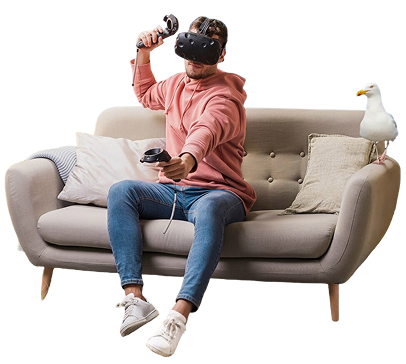
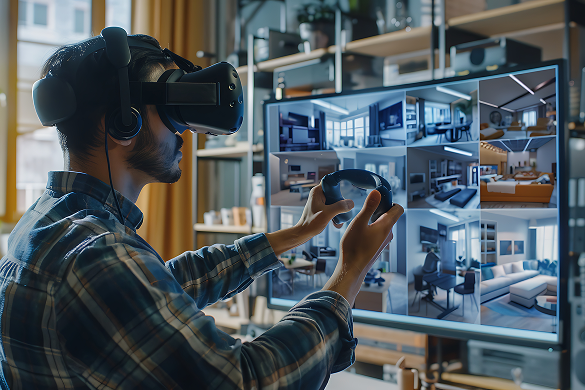
DevsTree specializes in designing immersive Virtual Reality applications that help businesses train teams, visualize products, and engage users effectively. As the best Virtual Reality App Development in UK, we deliver custom VR solutions using advanced tools, real-time interactions, and scalable architectures. Our approach focuses on performance, realism, and usability, ensuring impactful digital experiences that drive measurable results across industries through strategy, innovation, quality assurance, deployment, optimization, and long-term technical support services worldwide.


We deliver VR app development solutions that combine immersive design with reliable technology to create meaningful user experiences. Our team works closely with businesses to understand objectives, users, and environments, ensuring every VR application is practical, engaging, and aligned with real world use cases.
What sets us apart is our end-to-end approach and focus on performance, scalability, and usability. From concept and 3D design to deployment and ongoing support, we build VR applications that are stable, intuitive, and ready to scale helping organisations adopt virtual reality with confidence and measurable value.
 Easy Engagement
Certified Work
User-Friendly Interface
Experienced Developers
Easy Engagement
Certified Work
User-Friendly Interface
Experienced Developers

Our Virtual Reality Projects

We create VR action games that provide an amazing 3D experience that players love.

We give you real-life shooting experience by creating VR FPS games.

We offer the perfect option for those who love adventure with our VR Adventure game services.

Devstree creates interactive mind-developing puzzle games designed for Virtual reality platforms.

We create Sports VR games such as football, cricket and many others with beautiful graphics and 3D inclinations that are elective.

The many highly successful car and bike racing games were developed by our amazing team who are part of Unity VR game development.



DevsTree IT Solutions Services teamed up effectively and kept in touch regularly. They made both my apps and website. Their communication was solid, and their teamwork was impressive.
DevsTree IT Solutions team provided me with fantastic service from the very beginning, when we discussed my idea, to the end, when they delivered my app. They have a great team of designers and developers, and I am confident that they will be able to help me market my app as well.
Team was great to work with. They were process and goal-oriented, and they always made sure that our expectations were met. The working environment was supportive and encouraging. I would definitely recommend them to anyone looking for app development services, and I know that we can count on them for any app solutions.
 James
James
 March 2, 2025
In recent years, Virtual Reality (VR) technology has made significant…
Read more
 James
March 5, 2024
James
March 5, 2024
Augmented reality (AR) and virtual reality (VR) are two of…
Read more
 James
February 1, 2024
James
February 1, 2024
Introduction The rise of the metaverse is transforming the gaming…
Read more
Frequently Asked Questions
VR development means creating fully immersive, computer-generated 3D environments that users can explore and interact with via VR headsets (or other VR-compatible devices). Users feel “inside” the world — rather than just viewing something on a screen — making it ideal for games, training, simulations, virtual tours, interactive experiences, and more.
A wide range - including 3D games, simulations, training applications, virtual showrooms or tours (real-estate, architecture, retail), educational or learning modules, interactive storytelling/experiences, VR-based marketing or branding tools, virtual events or exhibitions, and more.
Typical steps include: requirement gathering → conceptualization & design (3D world / UI/UX for VR) → 3D modeling & environment creation → implementation of interactivity & logic → performance optimization & compatibility testing → QA & VR-specific testing (motion-comfort, latency, device testing) → deployment → post-launch maintenance and updates.
Depending on your target audience and application, VR apps may support dedicated VR headsets (like PC-VR or standalone VR headsets), or mobile-based VR (if optimized), assuming the user has compatible hardware (sufficient processing power, sensors, etc.). Proper hardware affects immersion, performance and user comfort.
