

 James
James
 April 22, 2025
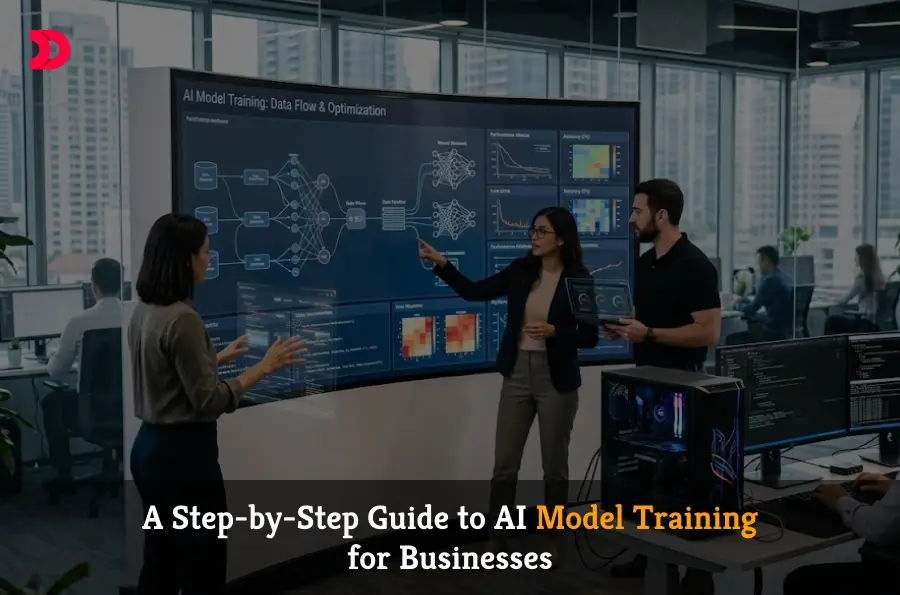
Artificial intelligence has quickly moved from being a buzzword to becoming a real business advantage. Companies are using AI to automate tasks, improve customer experience, increase efficiency, and make smarter decisions based on data. However, one of the biggest challenges businesses face is understanding how to actually train an AI model.
If you are planning to build an AI solution, knowing the step by step process will help you avoid confusion, reduce risk, and get better results. Whether you are building in-house or working with an AI development company, this guide will walk you through the complete journey in a practical and easy to understand way.
AI model training is the process of teaching a system how to learn from data. The model studies patterns, relationships, and trends within the data and then uses that learning to make predictions or decisions.
For example, a trained AI model can:
The better the data and training process, the more accurate and reliable your AI model will be.
Before you even think about algorithms or tools, start with clarity. AI should solve a real business problem, not just be implemented because it sounds advanced.
Ask yourself:
For example, instead of saying “we want to use AI,” define it clearly like “we want to reduce customer support response time by 30 percent” or “we want to improve product recommendations to increase sales.”
This step is critical because your entire AI model will be built around this goal.
Data is the backbone of any AI model. Without the right data, even the most advanced AI will fail.
Depending on your business use case, you may need:
Focus on collecting data that is:
Many businesses choose to work with an AI development company at this stage to ensure proper data strategy and structure.
Raw data is rarely usable as it is. It often contains errors, duplicates, missing values, or inconsistent formats. This is why data preparation is one of the most important steps in AI model training.
This step includes:
For example, if you are building a chatbot, your data needs to be structured and labeled so the model understands different types of user queries.
A well-prepared dataset directly improves the performance and accuracy of your AI model.
Not all AI models are the same. The type of model you choose depends on your business problem and the type of data you have.
Some common approaches include:
Choosing the wrong model can lead to poor results, so it is important to align the model with your business objective. This is another area where an experienced AI development company can guide you effectively.
This is the stage where your model starts learning from the data. The system processes the data, identifies patterns, and adjusts itself to improve accuracy.
During training:
This process may run multiple times until the model reaches a satisfactory level of accuracy.
Depending on the complexity, training can take anywhere from a few hours to several days.
Once training is complete, the next step is to test how well the model performs. This is done using a separate dataset that the model has not seen before.
Key evaluation factors include:
Testing helps identify whether the model is performing well or if it needs further improvement.
It also helps detect issues such as:
A well-tested model ensures reliability before moving to deployment.
After testing and validation, the model is ready to be deployed into a real business environment.
Deployment can include:
The goal is to make the AI solution accessible and usable in your daily operations.
A good deployment ensures:
AI is not a one-time setup. Once deployed, the model needs continuous monitoring and improvement.
Over time:
To keep your AI model effective, you should:
Businesses that continuously refine their AI systems gain long-term value and better results.
While AI model training offers many benefits, businesses often face challenges such as:
These challenges can slow down progress or lead to poor outcomes if not handled properly.
Partnering with an experienced AI development company can simplify the entire process and help you achieve better results faster.
Benefits include:
Instead of experimenting without direction, you get a structured and proven approach to building your AI solution.
Training an AI model may seem complex at first, but when broken down into clear steps, it becomes much more manageable. The key is to start with a clear goal, use the right data, choose the correct model, and continuously improve the system over time.
AI is not just about technology. It is about solving real business problems and creating value. When done right, it can transform the way your business operates and grows.
If you are planning to build an AI solution and want expert guidance, you can contact DevsTree IT Solutions to get started with the right approach and strategy.
 James
August 3, 2026
James
August 3, 2026
Artificial Intelligence has transformed the way businesses interact with customers.…
Read more
 James
July 29, 2026
James
July 29, 2026
Artificial Intelligence has changed the way software is built. Modern…
Read more
 James
July 7, 2026
James
July 7, 2026
Mobile applications are evolving faster than ever, and one of…
Read more
 James
May 22, 2026
James
May 22, 2026
The way people search for information online is evolving rapidly.…
Read more