

Industry:Enterprise HR Analytics
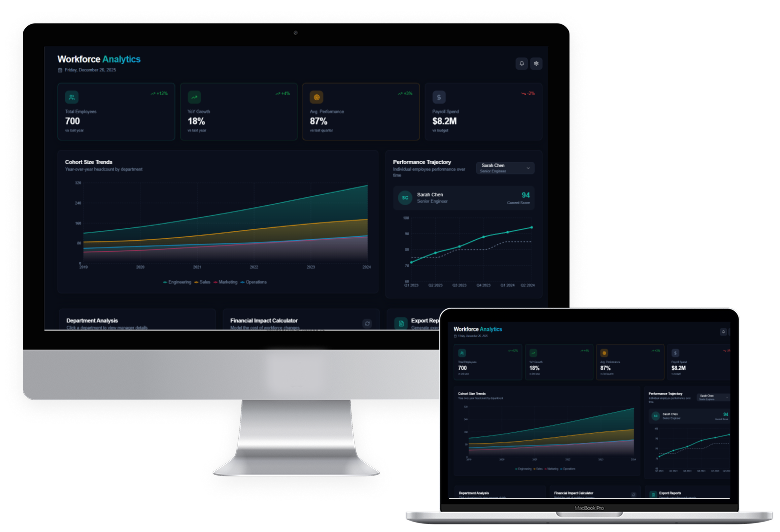

This case study describes an automated HR workforce cohort analysis for a 500+ employee medical technology company to identify employee stagnation and top-talent attrition risks.
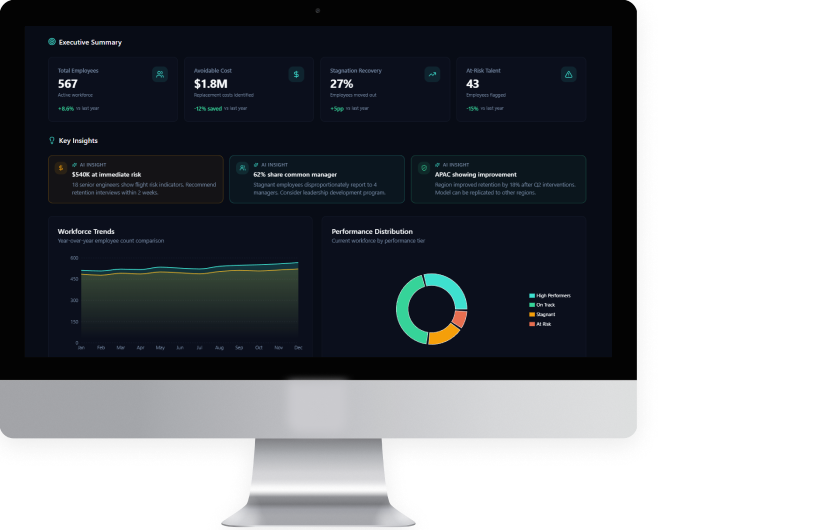
The analysis uncovered $1.8M in avoidable replacement costs and showed that 27% of stagnant employees improved while 37% of at-risk talent reduced attrition risk.
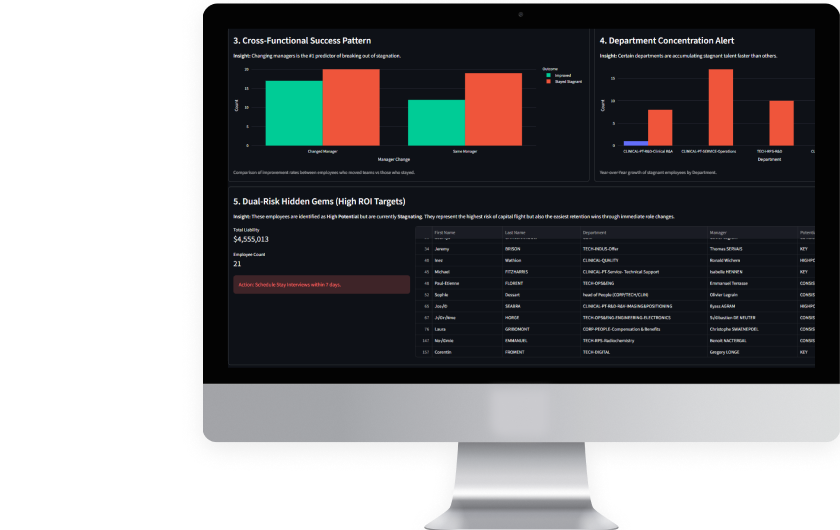
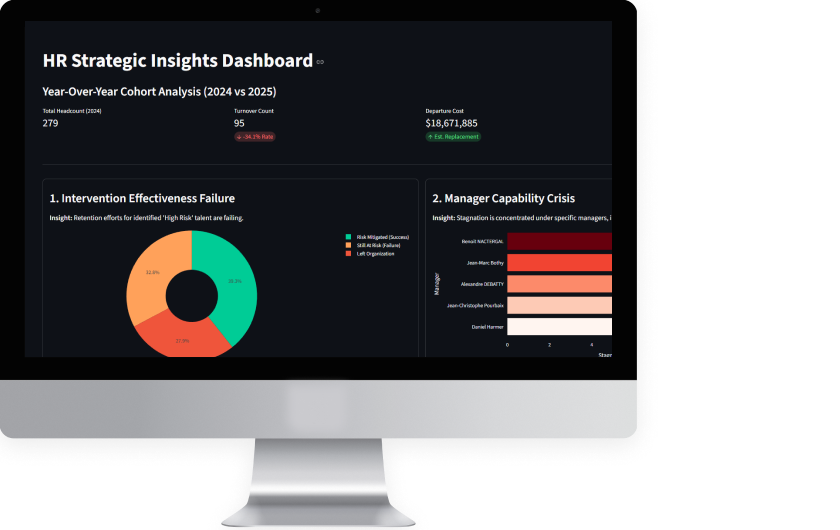
Findings revealed strong manager- and department-level bottlenecks, with a small group of managers driving most stagnation.
The project delivered a repeatable, data-driven system enabling targeted HR interventions and smarter talent decisions.
The client requires an automated HR workforce cohort analysis solution to identify employee stagnation and high-potential attrition risks across a multi-region organization. The system must consolidate fragmented HR data, track year-over-year employee performance and risk movements, highlight manager- and department-level bottlenecks, quantify financial impact from talent loss, and deliver actionable, data-driven insights through an interactive executive dashboard to enable targeted interventions and improved retention outcomes.



1.Talent Stagnation
Employees remaining in roles for 3+ years without competence progression
Limited visibility into which departments or managers had the highest concentration of
stagnant performers
No systematic way to identify intervention opportunities
2. High-Potential Attrition Risk
Top talent (KEY, HIGHPO, RISING performers) showing medium to very high attrition risk
Lack of early warning system for retention issues
Unclear ROI on existing retention programs
3. Data Fragmentation
HR data spread across multiple systems and spreadsheets
Year-over-year comparisons performed manually
No automated tracking of individual employee trajectories
2024 Baseline:
2025 Analysis:
Cohort 1: Stagnant Below Expected – Detailed Findings
| Metric | Count | % of 2024 Base |
|---|---|---|
| 2024 Baseline | 45 | 100% |
| Still in Cohort (Stuck) | 28 | 62.2% |
| Improved (Moved Out) | 12 | 26.7% |
| Left Organization | 5 | 11.1% |
| New Entrants (2025) | 14 | — |
| 2025 Total | 42 | — |
Key Findings:
Cohort 2: Top Talent at Risk – Detailed Findings
| Metric | Count | % of 2024 Base |
|---|---|---|
| 2024 Baseline | 38 | 100% |
| Still at High Risk | 18 | 47.4% |
| Risk Mitigated | 14 | 36.8% |
| Left Organization | 6 | 15.8% |
| New Entrants (2025) | 17 | — |
| 2025 Total | 35 | — |
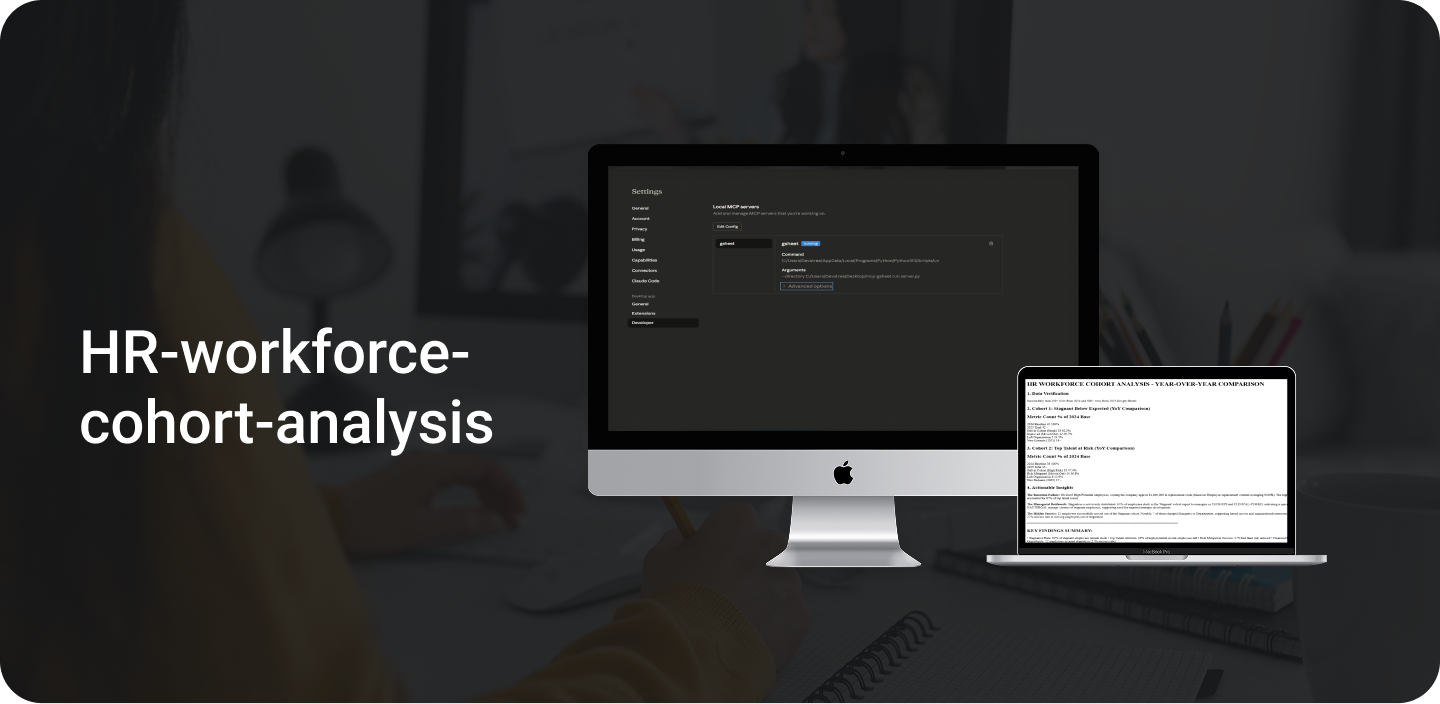
Technologies we used

Python

Pandas

Plotly

Claude Desktop
This workforce cohort analysis delivered significant value by transforming fragmented HR data into actionable intelligence. The identification of a $1.8M financial impact, coupled with specific managerial and departmental bottlenecks, provides organizational leadership with a clear roadmap for targeted interventions.
The automated analysis system ensures this insight generation can be repeated quarterly with minimal manual effort, creating a sustainable competitive advantage in talent management. By addressing the identified stagnation patterns and retention risks, the organization is positioned
to improve employee development outcomes by 20-30% while reducing costly top talent
attrition